Summary |
This chapter examines the variable-gain amplifier, or VGA, as the adaptive heart of the barcode scanner's analog signal chain. The central problem is one of sheer scale: the photodetector current produced by a clean white label held close to the scanner can be many thousands of times larger than the current produced by a scuffed, low-contrast label at the far edge of the working range. A fixed amplifier would either saturate on the near, bright target or bury the far, dim target in noise. The VGA solves this by continuously adjusting its amplification factor based on the signal it is receiving. This chapter explains why this matters not only as a circuit principle but as the enabling condition for reliable scanning across retail checkout, hospital bedside medication administration, warehouse receiving, manufacturing line tracking, and ticketing. Without a well-designed VGA, the scanner would work only under a narrow set of lighting and distance conditions. With it, the scanner becomes a practical tool that functions in the messy, variable world where barcodes actually live. |

|
1. The Problem the VGA Solves: A Signal That Refuses to Stay in One Place |
In the previous chapter, we followed the light path from the illumination source, through the printed barcode, and back to the photodetector. The detector converts returning photons into a current. That current is then converted into a voltage by a transimpedance amplifier. At this point in the signal chain, the engineer faces a fundamental difficulty. |
The amplitude of that voltage is not a single, predictable value. It swings wildly depending on factors that the scanner cannot control. A label printed on bright white paper and presented five centimeters from the window reflects a tremendous amount of light back into the detector. The same barcode symbology printed on a dirty, wrinkled label on a cardboard box thirty centimeters away reflects a tiny fraction of that light. The ratio between these two extremes can easily span several orders of magnitude. In technical terms, the dynamic range of the received signal is enormous . |
If the amplifier following the photodetector has a fixed gain, the designer must choose a compromise. Set the gain high enough to extract a usable signal from the distant, dirty label, and the near, clean label will drive the amplifier into saturation. The signal clips, the edges of the bars blur together, and the decoder receives garbage. Set the gain low enough to accommodate the bright near-field signal, and the far-field signal becomes so small that it is indistinguishable from the electronic noise floor of the amplifier itself. The bars and spaces disappear into the hiss. |
This is not a minor inconvenience. It is the central analog design challenge of the barcode scanner. A scanner that works only at a specific distance, or only with pristine labels, is not a useful product. It must work across the full range of conditions that real users encounter. |

|
2. What the VGA Actually Does: Adjusting the Magnifying Glass in Real Time |
The variable-gain amplifier is, conceptually, a magnifying glass whose power can be changed on the fly. It sits in the signal chain after the initial transimpedance stage and before the digitizing or edge-detection circuitry. Its job is to take whatever voltage it receives and scale it to a consistent, usable level for the next stage. |
The control mechanism is typically a feedback loop. A portion of the VGA's output is monitored by a control circuit. If the output is too large, the control circuit reduces the gain. If the output is too small, it increases the gain. This happens continuously, often on a timescale of microseconds to milliseconds, fast enough to track changes as the scanner moves across a label or as the operator changes the distance between the scanner and the barcode. |
The effect is that the signal presented to the digitizer stays within a comfortable range. The digitizer does not need to know whether the original light was bright or dim. It only needs to see clean transitions between bars and spaces. The VGA absorbs the variability of the physical world and delivers a normalized signal to the digital domain. |
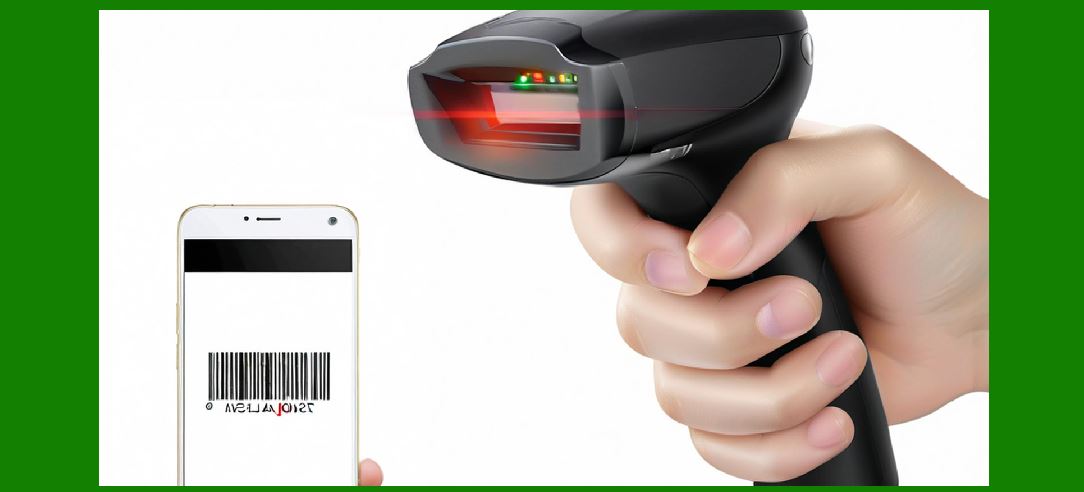
This principle is not unique to barcode scanners. It appears in audio recording, radio receivers, and telecommunications. But in barcode scanning, the range of variation is particularly severe because the input is optical and the distances and surface conditions are controlled by human hands and unpredictable environments. |
|
3. Why the VGA Matters in Retail Checkout: Speed, Throughput, and the Angry Customer |
Consider the retail point-of-sale environment. A cashier lifts a product from the cart and sweeps it across the scanner window. The product might be a large box of cereal held ten centimeters away, or a small candy bar held two centimeters away, or a heavy item that the cashier barely lifts and drags across the glass. The label might be on a curved surface, tilted at an angle, or partially obscured by a price sticker. |
The scanner must read the barcode on the first pass. If it fails, the cashier must try again. In a busy supermarket, a scanner with a poor VGA design would produce a stuttering, unreliable checkout experience. The customer notices. The line backs up. The cashier loses confidence in the tool. |
Retail scanners are engineered to handle this by combining a wide VGA range with fast gain switching. As the product moves through the scan volume, the VGA adjusts continuously. A white label on a dark package presents a high-contrast signal that the VGA can handle easily. A low-contrast label, such as a pale yellow barcode on a white background, produces a weak signal that requires more gain. The VGA must find the right level without introducing excessive noise or distortion. |
In self-checkout lanes, the problem is even more acute. The customer is not a trained operator. They may hold the item too close, too far, at a strange angle, or wave it erratically. The scanner must be forgiving. A well-designed VGA, paired with a wide dynamic range front end, allows the self-checkout terminal to read barcodes that a human cashier would instinctively reposition. This reduces frustration and keeps the line moving . |

|
4. The VGA in Healthcare: When a Misread Is a Safety Event |
The stakes are higher in healthcare. Barcode scanning at the patient bedside is used to verify that the right patient is receiving the right medication at the right dose. A nurse scans the patient's wristband and then the medication package. The system compares the two and alerts the nurse if there is a mismatch. |
The wristband is a challenging optical target. It is often printed on a synthetic material that may be curved tightly around the wrist. It may be wrinkled, smudged with hand sanitizer, or partially covered by a sleeve. The medication package may be a small vial with a tiny barcode, or a blister pack with a label that is not perfectly flat. |
If the VGA fails to adapt to these conditions, the scan fails. The nurse must try again, or worse, override the system. A scanner that requires multiple attempts to read a wristband is a scanner that nurses will stop trusting. They will find workarounds. The safety benefit of barcode medication administration evaporates. |
Healthcare scanners are therefore designed with VGAs that prioritize reliability over raw speed. The gain adaptation must be smooth and stable, avoiding oscillations that could cause the decoder to misread a bar width. The signal chain must also handle the low-contrast printing common on some medication labels, where the barcode may be printed in a color that does not provide strong contrast against the background . |
The VGA's role here is quiet but essential. It ensures that the scanner sees the same clean signal whether the wristband is fresh out of the printer or has been worn for three days in a busy ward. |
|
5. Warehousing and Logistics: Distance, Dust, and the Full Pallet |
A warehouse receiving dock is the opposite of a clean retail checkout. Pallets of goods arrive wrapped in plastic, covered in dust, and labeled with barcodes that may be printed on cheap paper and affixed at odd angles. The worker may be scanning from a forklift, several meters away from the label. Or they may be scanning a single small item on a shelf at close range. |
The dynamic range here is extreme. A label on a pallet at five meters returns very little light. The VGA must amplify that tiny signal without amplifying the ambient noise from overhead lights and sunlight streaming through loading dock doors. A label on an item held in the worker's hand at thirty centimeters returns far more light, and the VGA must reduce gain to avoid saturation. |
Industrial scanners often use a combination of optical design and electronic gain control to manage this. The optical system may be designed to limit the amount of light reaching the detector from very close targets, effectively compressing the dynamic range before the signal even reaches the amplifier . The VGA then handles the remaining variation. This division of labor between optics and electronics is a recurring theme in scanner design. Neither alone can solve the problem. |
In warehouse picking applications, the scanner is used continuously for hours. The VGA must be stable over temperature changes and aging. A gain control loop that drifts over time will cause intermittent read failures that are difficult to diagnose. The worker experiences it as a scanner that 'sometimes just doesn't want to work,' a frustrating and productivity-killing behavior. |

|
6. Manufacturing and Work-in-Process Tracking: The Harsh Reality of the Factory Floor |
On a manufacturing line, barcodes track parts, assemblies, and materials through every stage of production. A label may be applied to a metal casting that is still warm from a machining operation. It may be covered in cutting fluid or metal shavings. It may be scanned by a fixed-mount scanner as it moves past on a conveyor at high speed. |
The VGA in a fixed-mount industrial scanner faces a different challenge from a handheld unit. The distance to the barcode is fixed by the installation, but the surface conditions vary enormously. A shiny metal part reflects light differently from a matte plastic part. A label that is perfectly flat presents a clean signal; a label wrapped around a cylindrical part presents a signal that changes as the part rotates. |
In these applications, the VGA is often paired with automatic gain control that responds to the envelope of the signal rather than instantaneous peaks. This prevents the gain from chasing noise spikes or responding too aggressively to small variations in reflectivity. The goal is a stable, average gain that keeps the signal within the usable range for the majority of the scan, with enough headroom to accommodate occasional extremes. |
The consequences of VGA failure in manufacturing are immediate. A missed read on a work-in-process tracking station can cause a part to be routed to the wrong assembly station, or a completed unit to be shipped without its final inspection record. The line may stop while the error is investigated. The cost of downtime in a modern factory is measured in thousands of dollars per minute. |
|
7. Ticketing and Access Control: Speed Under Pressure |
A concert venue or transit station presents a different set of conditions. The barcode is on a ticket or a phone screen. The user is in a hurry. The lighting may be dim or uneven. The ticket may be crumpled, or the phone screen may be cracked or smeared with fingerprints. |
Mobile ticketing adds a particular challenge. The barcode is displayed on a glowing screen rather than printed on paper. The brightness of the screen varies. The refresh rate of the display can interact with the scanner's illumination in ways that produce flicker or banding in the received signal. The VGA must handle these artifacts while still extracting the barcode information. |
At a transit gate, the scanner is expected to read a ticket in a fraction of a second. The VGA's adaptation speed is critical. If the gain takes too long to settle after the ticket enters the scan zone, the read is delayed. If the gain overshoots and oscillates, the decoder may fail to find valid edges. The control loop must be tuned for fast settling without instability. |
The same principles apply to event ticketing, where a scanner may be used by a staff member holding a handheld device at a crowded entrance. The VGA must cope with the ambient light of the venue, the movement of the ticket, and the variable distance between scanner and barcode, all while delivering a read in the brief moment the ticket is presented. |

|
8. The Interaction Between VGA and Digitization: Why Gain Accuracy Matters |
The VGA does not operate in isolation. Its output feeds into the next stage of the signal chain, which may be an analog-to-digital converter or, in many laser scanners, an edge-detection circuit that identifies transitions between bars and spaces by finding peaks in the derivative of the signal . |
If the VGA's gain is inaccurate or unstable, the downstream circuitry suffers. A gain that is too high causes clipping, which flattens the peaks of the signal and destroys the timing information encoded in the bar widths. A gain that is too low leaves the signal buried in noise, causing the edge detector to trigger on noise rather than real transitions. |
The VGA must therefore be designed with careful attention to linearity. It must amplify the signal without distorting its shape. It must respond quickly to changes in signal amplitude without introducing transients that the decoder might misinterpret as barcode features. And it must maintain its accuracy across the full range of operating temperatures and supply voltages that the scanner will encounter in the field. |
This is where the analog design becomes as much art as science. The control loop must be stable under all conditions. The gain element itself must be linear. The feedback mechanism must not introduce delays that cause the gain to lag behind fast changes in the signal. |

|
9. Why the VGA Is the Unsung Hero of the Universal Signal Chain |
In the popular imagination, barcode scanners are digital devices. They read a code and output a number. But the reality is that the scanner is an analog instrument that performs a difficult analog task, and only at the very end of the chain does the signal become digital. |
The VGA is the component that makes the analog task tractable. Without it, the scanner would be a fair-weather device, working only under narrow conditions of distance and label quality. With it, the scanner becomes a tool that can be handed to a cashier, a nurse, a warehouse worker, or a ticket taker and trusted to work. |
The VGA's contribution is invisible when it works well. The user sees a scan, not a gain adjustment. But every successful scan in every application is a small victory of analog design over the variability of the physical world. |

|
Detailed Summary |
The variable-gain amplifier occupies a pivotal position in the barcode scanner's signal chain. It receives a voltage from the transimpedance amplifier that may vary by orders of magnitude depending on the distance to the barcode, the reflectivity of the label, and the ambient conditions. Its task is to scale that voltage to a consistent level that the downstream digitizer or edge detector can process reliably. |
This chapter has examined the VGA's role across several industries. In retail, the VGA enables fast, first-pass reads at checkout and self-checkout, accommodating the unpredictable presentation of products by both trained cashiers and untrained customers. In healthcare, it supports the reliable reading of wristbands and medication labels that are often curved, smudged, or printed with low contrast, where a failed read can compromise patient safety. In warehousing and logistics, the VGA handles the extreme dynamic range between pallet labels scanned at a distance and item labels scanned up close, in environments with dust and variable lighting. In manufacturing, it provides stable gain control for fixed-mount scanners tracking parts through production, where missed reads cause costly downtime. In ticketing and access control, it enables fast reads of printed and mobile tickets under time pressure and variable lighting. |
The chapter has also explained the technical requirements that make the VGA effective. The gain control loop must be fast enough to track changes as the scanner moves, stable enough to avoid oscillation, and linear enough to preserve the shape of the signal. The VGA must work in concert with the optical design, which may pre-compress the dynamic range before the signal reaches the electronics, and with the digitization stage, which depends on a clean, undistorted signal to extract accurate bar-width measurements. |
The VGA is not a glamorous component. It does not appear in marketing materials. But it is the component that transforms the barcode scanner from a laboratory curiosity into a practical instrument. It is the answer to the question of how a single device can read a bright label at close range and a dim label at a distance, in a supermarket, a hospital, a factory, or a stadium, without requiring the user to adjust anything. The VGA adjusts for them. That is the quiet, essential magic of the universal signal chain. |
 cs@easiersoft.com