Article Summary: This article continues from the preceding chapters on analog signal conditioning and the digital boundary, focusing on what happens after the digitized barcode signal enters the decoder. It explains how that serial bitstream of bar and space widths is transformed, within a microcontroller or a dedicated digital signal processor, into meaningful character data. The central argument is that the decoder is not merely a logic unit but the final filter through which the uncertainties of the physical world pass at the digital boundary. Through practical cases from retail, healthcare, automotive manufacturing, logistics sorting, and aerospace maintenance, the article shows how the same set of decoding principles is given different design weights in radically different environments. |
|
1. From Edges to Bits: What the Decoder Actually Sees |
What the decoder receives is not the raw waveform but a string of already-adjudicated timing marks. In the preceding digitization stage, the analog voltage signal is sliced into discrete transition points by a comparator or an analog-to-digital converter. The start and end of every bar, and the beginning and termination of every space, are recorded as a timestamp or a count of clock cycles. What the decoder gets is this end-to-end sequence of numbers, representing the time intervals between adjacent edges, that is, the relative widths of the bars or spaces. |
The essence of this bitstream is a set of ratios, not absolute dimensions. Barcode standards do not specify that a 'narrow bar' must be a certain number of millimeters; they specify that the ratio between narrow and wide elements must fall within a certain tolerance range. The first thing the decoder must do is find the fundamental unit width within this sequence of time intervals, usually called the module width. Once the module width is locked, all subsequent wide-versus-narrow judgments have a ruler. |
Yet real-world signals are never perfect. Rough printing, curved paper, oblique scan angles, and motion blur all cause small jitters in edge positions. The decoder faces a noisy ratio sequence, and its task is to recover the character sequence in the semiotic sense. This process requires both rigid rule matching and statistical fault tolerance. |

|
2. Microcontrollers and DSPs: Two Personalities of Decoding Hosts |
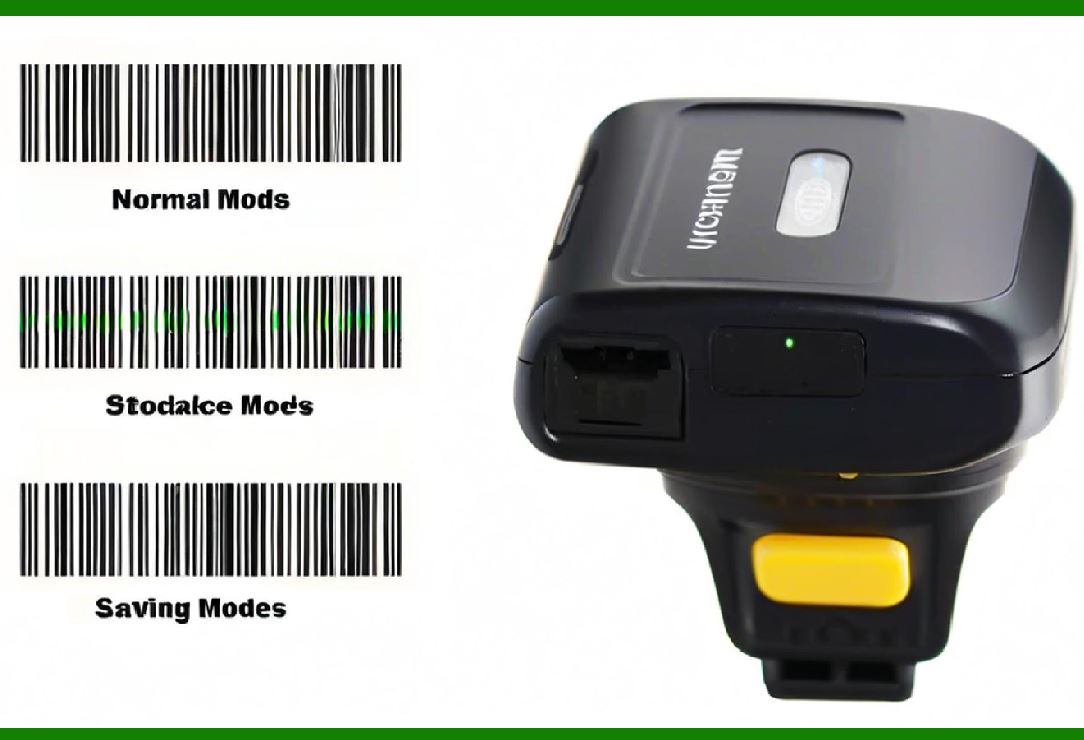
In the vast majority of modern barcode scanners, the decoding task is handled by a microcontroller. A microcontroller is a complete system on chip, integrating a processor core, memory, timers, and various peripheral interfaces. Its advantage lies in control and coordination: it can simultaneously manage the trigger timing of the scan engine, the sounding of the beeper, interface communications, and the execution of the decoding algorithm itself. For a workload like one-dimensional barcode decoding, a microcontroller running at tens of megahertz is more than sufficient. |
Dedicated digital signal processors earn their place in two-dimensional symbologies and high-speed scenarios. The DSP architecture is optimized for multiply-accumulate operations and loop execution, capable of completing more arithmetic-intensive tasks per unit time. When a scanner must handle edge detection, codeword localization, and error-correction computation in two-dimensional images, a DSP can significantly shorten the latency from capture to output. In some high-end industrial scanners, the microcontroller handles system scheduling while the DSP devotes itself to image processing and decoding, with the two working in division of labor. |
Regardless of the host, the updatability of decoding firmware is a key design consideration throughout the product lifecycle. A common practice is to use the microcontroller as the master, transferring the DSP's required program from flash memory into the latter's memory at startup. This approach allows the entire device to gain new life through a firmware upgrade when a new symbology appears or a defect is discovered in the original algorithm, without replacing hardware. |
|
3. Retail Checkout: Speed, Tolerance, and First Impressions |
The retail checkout counter is one of the most demanding real-time tests a barcode decoder faces. Cashiers do not think about whether the scanner is working; they expect to hear the confirming beep the instant they pull the trigger or slide an item across the window. From the moment edge data enters the decoder to the moment character data is sent out, the entire chain's latency must be compressed to a level humans can barely perceive. The decoder's strategy here is aggressive: it tries multiple threshold combinations, and once a candidate sequence passes checksum verification, it outputs the result immediately without looking back for a 'better solution.' |
The print quality of retail barcodes varies widely, and the decoder must build in sufficient tolerance. A thermal printer may spread bar edges due to overheating, and a laser printer may produce spurious edges due to uneven toner distribution. The 'multi-threshold scanning' technique in decoding algorithms exists precisely for this: the same digitized signal is repeatedly attempted with different sensitivities assumed for bar-space transitions until a result under some threshold passes the symbology's verification rules. This brute-force attempt is implemented as software loops on the microcontroller, at a controllable computational cost, in exchange for read success rates on poor labels. |
The retail scenario also shapes a hidden behavioral pattern in the decoder: it must learn to refuse. A credit card, an employee badge, or even another product's barcode may be sitting on the counter. The decoder is configured to accept only symbols matching specific length and prefix rules; other legitimate but non-product codes are silently ignored. This is a direct embedding of commercial rules into technical rules within the decoding logic. |

|
4. The Medical Bedside: Decoding Correctness Equals Patient Safety |
In a hospital's medication closed loop, every character the decoder outputs is directly tied to a specific patient and dose. A nurse scans a patient's wristband, then scans the medication packaging, and the system compares whether the two match. The decoder here does not need extreme speed but needs near-absolute reliability. A single character misread because of a wrinkled wristband could result in the wrong patient receiving the wrong medication. The requirement for the decoder in medical scenarios shifts from 'fast' to 'stable' and 'verifiable.' |
For this reason, decoding strategies in medical scenarios tend toward conservatism. When the decoder encounters a signal of questionable quality, it prefers to declare failure and request a rescan rather than risk outputting a possibly erroneous candidate. Checksum verification is strictly enforced here; any sequence failing verification is discarded, no matter how close it is to a legitimate code. This conservatism would be seen as inefficient in retail, but at the bedside it is a safety feature. |
Pilot data from the UK's National Health Service reveals the systemic benefits of this conservative decoding. In hospitals using barcode scanning to track implantable devices, the average response time for product recalls dropped from eight days to thirty-five minutes. The decoder's role here is not merely reading a string of digits; by locking a physical device to a digital record, it greatly reduces the administrative friction between discovering a problem and locating affected patients. Decoding correctness thus acquires clinical weight. |

|
5. Automotive Manufacturing: Maintaining Traceability Through Oil, Metal, and Speed |
The automotive production line environment poses physical-level challenges to the decoder. Direct part marks are often tiny two-dimensional codes dot-peened onto metal surfaces; these codes have extremely low contrast and may be partially obscured by cutting fluid or oil. In the digitized signal the decoder receives, the edges representing modules may drown in noise. The decoding algorithm here must work closely with the illumination strategy, reconstructing a decodable codeword through multi-frame accumulation or adaptive thresholding. |
From components to final assembly, every workstation the decoder serves contributes a node to the traceability chain. Once the code on a bolt is read, its identity is bound to the engine assembly it enters; once the engine assembly's code is read, it is bound to the chassis number; once the final vehicle identification number is read, a digital genealogy from raw material to finished vehicle is closed. A decoder failure in this chain means a broken traceability chain, and a broken traceability chain in a recall event means the problem's scope cannot be defined, forcing an expanded recall. |
Another implicit requirement for decoders in the automotive industry is consistency. Scanners from different suppliers, different batches, and different origins should output exactly the same result when reading the same direct part mark. Parameter tuning in the decoding algorithm therefore cannot be overly aggressive or depend on edge features under one particular lighting condition. It must produce stable and repeatable output across a wide range of input conditions, even if this means sacrificing some extreme read capability. |

|
6. Logistics Sorting: The Decoder as Throughput Bottleneck |
In express parcel sorting centers, the decoder's processing speed directly determines the throughput ceiling of the entire sorting line. Parcels sweep past the scan window at several meters per second on the conveyor, leaving the decoder a time window measured in milliseconds. If the decoder fails to output a valid result within the brief buffer period after a parcel passes, that parcel is diverted to an exception-handling lane requiring manual intervention. Every manual intervention directly adds to the sorting center's operating costs. |
Barcodes in logistics scenarios often face three-dimensional pose challenges. Only one of a parcel's six faces bears a barcode, and that face may point in any direction. Six-sided scanning systems solve this problem with multiple scanners working simultaneously, but the decoder here faces a flood of concurrent data. It must quickly determine which signal path contains a complete, decodable symbol and complete decoding and output while signals from other paths continue to pour in. This multi-channel arbitration logic is a distinctive feature of logistics decoders compared with checkout-counter decoders. |
In airline baggage handling, the consequences of decoding failure are amplified further. A bag that fails to be correctly decoded may be loaded onto the wrong flight or circulate repeatedly through the sorting system until discovered manually. Baggage tags typically use high-density one-dimensional or two-dimensional codes printed on soft paper labels, which may be squeezed, folded, or partially worn during transport. The decoder must maintain a sufficient read rate under these degraded conditions, because baggage sorting systems do not prepare a retry opportunity for every bag. |

|
7. Aerospace and Heavy Industry: When Barcodes Must Survive for Decades |
Parts traceability in aviation maintenance requires the decoder to read barcodes that have endured thousands of flight hours and multiple cleaning cycles. A metal nameplate affixed to a landing gear component may have blurred edges from repeated abrasive blasting, or partial fading from thermal cycling. The decoder here faces a signal far removed from its original printed state: edge steepness has been eroded, and wide-narrow ratios have shifted. |
Decoding strategies in such scenarios need to incorporate historical priors. Maintenance records already know which model this part should belong to and what the general format of its serial number is. The decoder can use this prior information as a constraint, applying probability weights to candidate characters during decoding. An edge sequence that would be judged ambiguous in a general scenario can be deterministically resolved under the constraint that the position should be a digit. This 'informed decoding' is a common engineering practice in the traceability of critical components in aviation, rail, and energy facilities. |
Decoders in heavy industrial environments also face persistent electromagnetic interference. Electromagnetic noise generated by large motors, welding equipment, and variable-frequency drives can couple into the digitization circuit, creating spurious transitions in the bitstream. Filtering logic in the decoding firmware must distinguish which edges are true features of the barcode and which are occasional products of noise. This is typically done by checking the statistical consistency of edge intervals: an isolated transition whose width is out of proportion to all surrounding elements is judged as noise and discarded. |

|
8. The Philosophy of the Digital Boundary: What the Decoder Knows and Does Not Know |
The decoder is a device designed to 'know just enough.' It knows how to extract module width from edge intervals, how to map wide-narrow patterns to characters, and how to verify checksums. But it does not know, and does not care, whether this string of characters represents toothpaste or a cardiac stent. This deliberate ignorance is the core advantage of layered design: the decoder's generality allows the same chip to be deployed at a checkout counter and in an operating room, while the assignment of meaning is left to upper-layer application systems. |
However, this ignorance also delineates the true position of the digital boundary. When the decoder outputs a character sequence, it is in effect saying: under the given symbology rules and current signal quality, this is the most probable interpretation. What it does not say is whether this interpretation truly corresponds to the physical object. A deliberately forged barcode, a misapplied label, a parcel swapped in transit all produce equally legitimate bitstreams as far as the decoder is concerned. Inside the digital boundary are deterministic logic operations; outside it are the uncertainties of the physical world and human behavior. |
Therefore, a mature system design does not place all trust in the decoder. Medical systems use dual scanning of wristband and medication for cross-verification; automotive traceability uses data correlation across multiple workstations to detect anomalies; logistics sorting uses auxiliary weight and volume measurements to flag suspicious parcels. The decoder provides the entrance to the digital world, but the path beyond the entrance needs more checkpoints. Understanding this is the final destination of understanding the entire chain from photons to bits. |

|
Detailed Summary |
This article unfolds around the process after the digitized barcode signal enters the decoder, elaborating on three levels: principles, host architectures, and industry applications. |
At the level of principles, the decoder receives a sequence of time intervals between edges; its core task is to recover module width ratios and map wide-narrow patterns to characters. Noise and distortion in real signals require decoding algorithms to possess multi-threshold trial and statistical fault tolerance. |
At the level of host architectures, microcontrollers have become the mainstream choice thanks to their integration and control capabilities, while dedicated digital signal processors provide computational support in two-dimensional decoding and high-speed scenarios. Firmware updatability is a key design element for products adapting to new symbologies and fixing algorithm defects. |
At the level of industry applications, retail checkout pursues speed and tolerance for poor labels; the medical bedside trades conservative decoding for patient safety; automotive manufacturing maintains traceability chain integrity under harsh physical conditions; logistics sorting treats decoding speed as a throughput bottleneck; and aerospace maintenance uses historical priors to resolve severely degraded barcode signals. Together these scenarios show that the decoder's design weights are never singular but are shaped by the least compromiseable constraint in the deployment environment. The decoder outputs bits, but what determines the meaning of those bits is always the world beyond them. |
 cs@easiersoft.com