48. The Laser Scanner's Electrical Advantage: Signal-to-Noise Ratio and the Flying Spot | Summary: This article explains why the laser scanner's concentrated flying spot delivers a decisive electrical advantage over floodlight illumination, and then surveys how that advantage plays out across logistics, retail, manufacturing, healthcare, and other industries where speed and reliability under real-world conditions matter more than raw image capture. | The laser scanner does not illuminate the whole barcode at once. It launches a narrow beam from a small semiconductor laser, sweeps that beam across the symbol with a moving mirror, and measures the light that bounces back point by point as the spot travels. This is the flying spot: a tiny, intense probe of light that visits every bar and space in sequence, carrying information about reflectance back to a photodetector that needs only to track a single rapidly varying signal. The engineering consequence of this arrangement is profound, and it begins with a simple fact of photon economics. A one-milliwatt laser focused into a spot a few tens of micrometers across puts an enormous number of photons onto each resolvable element of the barcode in the brief instant the spot dwells there. An LED floodlight, by contrast, spreads its emission over a wide area and a wide angle, so only a small fraction of its photons ever return from any given bar or space. The laser scanner therefore enjoys a signal-to-noise ratio that an LED-based system can match only with longer exposure, larger optics, or heavier signal processing. | 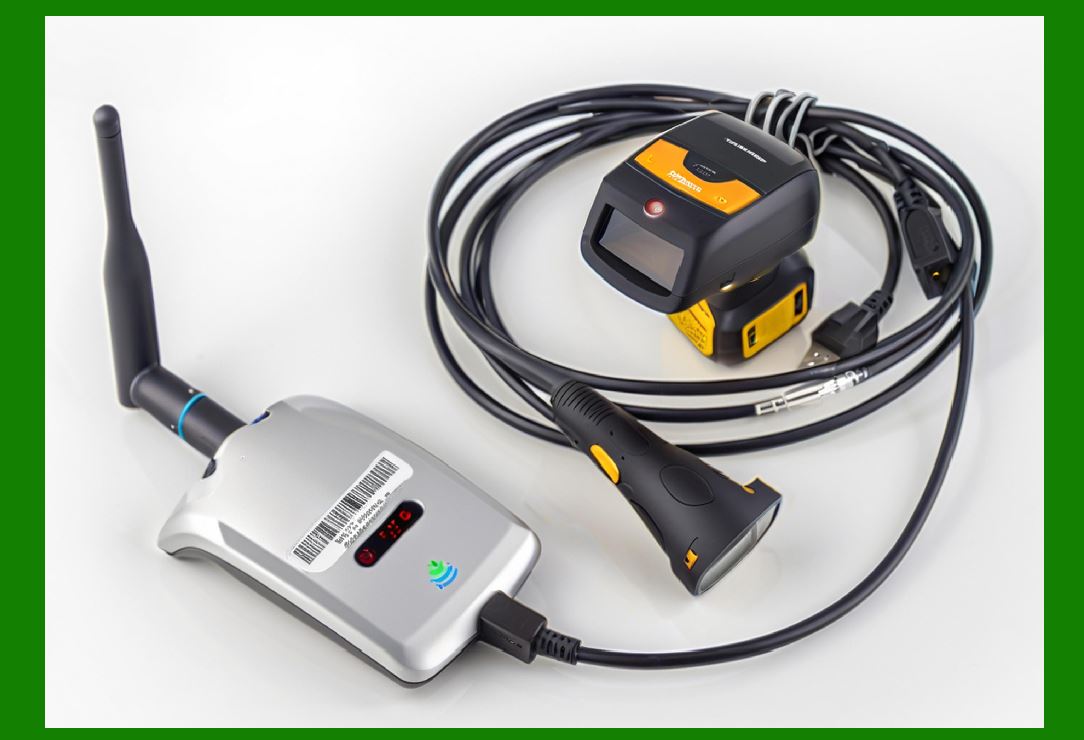
| This difference in photon budget translates directly into demands on the receiver electronics. The transimpedance amplifier, or TIA, is the first active stage after the photodiode. Its job is to convert the tiny photocurrent into a usable voltage while adding as little noise as possible. When the incoming signal is strong, the TIA can use a lower feedback resistance, which keeps the gain modest but preserves bandwidth. A wide bandwidth is essential because the flying spot is moving fast. In a typical handheld scanner, the beam may cross the entire barcode in a small fraction of a millisecond, and the return signal pulses at frequencies measured in hundreds of kilohertz to several megahertz. If the TIA cannot pass those frequencies without excessive phase distortion or attenuation, the edges of the bars blur together and the decoder loses the timing information it needs. The laser's concentrated spot makes the signal strong enough that the TIA does not need to sacrifice bandwidth for gain. An LED floodlight system, forced to integrate light over a much larger area for a much longer time, faces the opposite tradeoff: it must either accept a slower response or amplify a weaker signal with a higher-gain, narrower-bandwidth front end that is more vulnerable to noise and interference. | The practical value of this electrical advantage becomes clearest when we leave the bench and look at what scanners actually do in the world. The flying spot's signal-to-noise ratio is not an abstract specification. It is the reason a scanner can read a barcode on a box moving down a conveyor at high speed, or on a patient wristband under dim hospital lighting, or through the scratched and scuffed label on a returned package. Each of these situations stresses the receiver in a different way, and in each one the laser's photon concentration buys margin that the system designer can spend on speed, range, or tolerance to imperfect symbols. | 
| Consider first the logistics and parcel-handling industry, where laser scanners remain the workhorse for high-throughput sortation. A package conveyor may move at two to three meters per second, and the barcode may be presented at an unpredictable angle or partially obscured by packing tape. A fixed-mount laser scanner with an omnidirectional scan pattern can project dozens of scan lines across the symbol in the time the parcel crosses the scan window, and each line benefits from the flying spot's strong return signal. The TIA in such a scanner must have enough bandwidth to resolve the narrowest bar in the symbol at the highest line speed the scanner supports. Because the laser spot delivers a high photon flux, the TIA can be designed with a modest transimpedance and a wide closed-loop bandwidth, avoiding the gain-bandwidth squeeze that would degrade edge timing. The result is the familiar reliability of laser-based tunnel scanners in distribution centers, where a missed read means a manual exception and a cost penalty. The signal-to-noise advantage is what allows these scanners to maintain decode rates above a thousand reads per second in real time under the vibration and ambient light variations of a working conveyor line . | 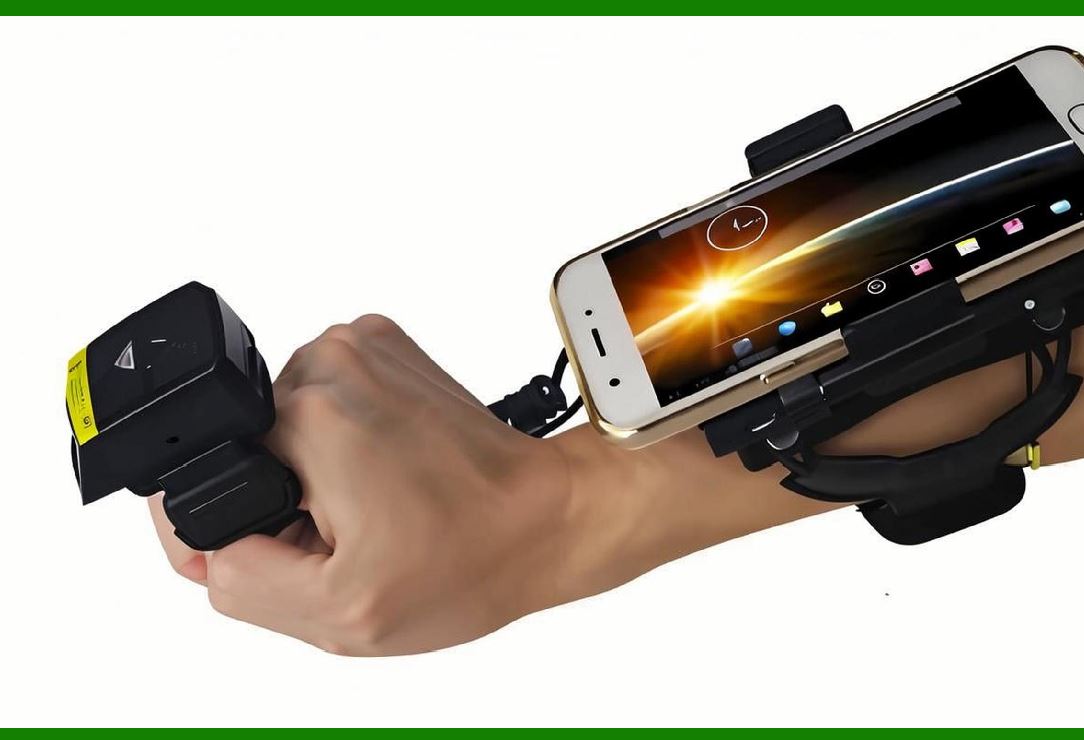
| Retail point-of-sale represents a different set of demands. The scanner at a checkout counter must be fast, but it must also be tolerant of presentation angle and motion. A cashier sweeps a product across the scan window, often without pausing, and the scanner must capture the barcode in the brief window of visibility. Laser scanners in this role use a scanning pattern that covers the window in multiple directions, and the flying spot's strong signal allows the decoder to extract valid edge timings even from a single partial sweep. The TIA's wide bandwidth preserves the sharp transitions between bars and spaces, which is critical when the symbol is printed on a curved or reflective surface. A cereal box with a glossy finish can produce specular highlights that momentarily overwhelm the photodiode; the laser's concentrated spot and the receiver's fast recovery from saturation allow the scanner to ride through these glints and continue decoding. LED floodlight systems, which illuminate a larger area and integrate over a longer interval, are more vulnerable to these reflections because the returned signal is weaker and the receiver must operate at higher gain, making saturation recovery slower. | 
| Manufacturing and automated assembly lines impose yet another set of constraints. A laser scanner mounted on a robot arm or beside a high-speed packaging machine must read barcodes on parts that may be small, closely spaced, or printed with low contrast. The flying spot can be focused to a very small diameter at a specific working distance, which means the spot's energy is concentrated on the symbol rather than wasted on the surrounding surface. This concentration is especially valuable when the barcode is etched or dot-peened onto a metal surface, where the contrast between bars and spaces is low. The returned signal is weak in absolute terms, but it is still strong relative to the receiver noise because the laser spot is small and the photodiode collects only the light from that spot. The TIA can therefore operate at a gain that preserves bandwidth, and the decoder can resolve the edges of the symbol even when the reflectance difference between bar and space is modest. In electronics manufacturing, laser scanners are used to track printed circuit boards through assembly stations, where the barcode may be only a few millimeters wide and the scanner must read it at a fixed distance without contact. The flying spot's signal-to-noise ratio makes this possible with a receiver that is simple, fast, and resistant to the electrical noise of the surrounding machinery. | 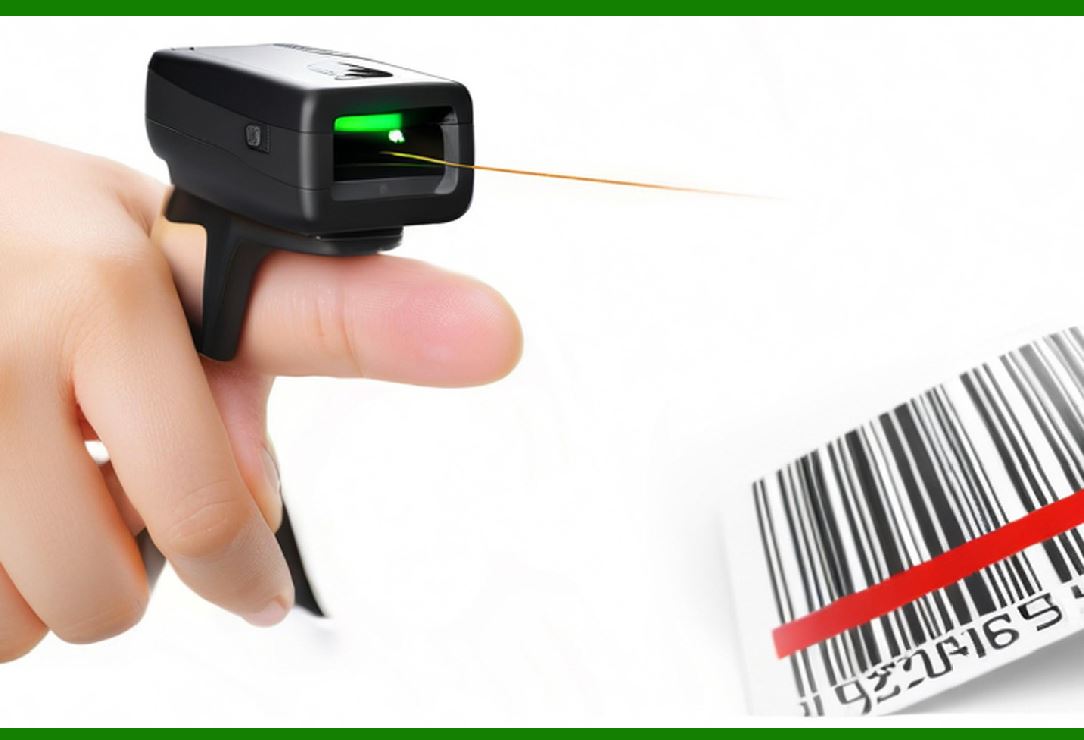
| Healthcare applications have grown rapidly, driven by regulatory requirements for traceability and patient safety. A laser scanner at a medication dispensing station or a patient bedside must read barcodes on syringes, vial labels, and wristbands that may be curved, small, or printed with variable contrast. The scanner must also be safe for use near patients and staff, which is why the lasers used in these devices are low-power semiconductor diodes, typically well under the limits for Class 1 or Class 2 laser products. The flying spot's efficiency means that even a sub-milliwatt laser can deliver enough photons per resolvable element to achieve reliable reads at distances of several inches to a foot, without the need for high-gain receivers that would be more susceptible to ambient light interference from overhead fluorescent or LED fixtures. The TIA in a healthcare scanner is designed to reject the low-frequency flicker of room lighting while passing the high-frequency edge information of the barcode signal. Because the laser signal is strong, the receiver can use AC coupling or high-pass filtering to suppress the ambient flicker without compromising the barcode signal's integrity. This is a direct benefit of the signal-to-noise margin: the designer can spend some of that margin on interference rejection rather than on raw sensitivity. | 
| The automotive industry provides a useful case study in the limits and strengths of laser scanning. On an assembly line, laser scanners read barcodes on engine blocks, transmission housings, and body panels as they move through stations. The symbols may be printed on labels that are exposed to oil, coolant, and metal dust, and the scanner may be mounted several feet from the line. The flying spot's ability to concentrate light on a small area allows the scanner to read at these distances with a receiver that does not require exotic cooling or enormous optics. However, the same industry also illustrates where laser scanning reaches its limits. Two-dimensional symbols, such as Data Matrix codes used for direct part marking, cannot be read by a simple single-line flying spot scanner because the beam visits only one line at a time. Rastering or omnidirectional laser scanners can cover a two-dimensional area, but image-based readers have largely taken over that role because they capture the entire symbol in a single exposure. The laser's electrical advantage is greatest for one-dimensional symbols, where the flying spot's serial scan matches the structure of the code and the receiver's bandwidth can be optimized for edge timing rather than for pixel digitization. | 
| Warehouse and inventory management represents one of the largest deployments of laser scanning technology. Handheld laser scanners are used to pick, put away, and cycle-count inventory in warehouses where lighting may be uneven and labels may be faded or damaged. The scanner's laser spot is visible to the operator as a bright line on the target, which helps with aiming and reduces the time spent searching for the barcode. Under the hood, the TIA's wide bandwidth and the flying spot's strong return signal allow the decoder to extract valid edge timings even when the label is partially obscured or printed on a crumpled surface. A warehouse worker may scan hundreds of items per shift, and each scan must be fast and reliable. The laser scanner's signal-to-noise ratio translates into a decode latency that is short enough that the scanner feels instantaneous to the user. This perceived immediacy is not a minor convenience; in a high-volume operation, a fraction of a second saved per scan adds up to significant labor savings over a shift. The same signal-to-noise margin also allows the scanner to operate at a range of distances, from a few inches to several feet, without the operator needing to adjust settings or change devices. | 
| The airline and baggage-handling industry uses laser scanners in environments where ambient light can be intense and unpredictable. Baggage tags are printed on paper or thermal labels and are often crumpled, scuffed, or partially covered by other tags. A laser scanner at a check-in counter or a bag-drop station must read the tag quickly while the agent or passenger holds it at an arbitrary angle. The flying spot's concentrated beam and the receiver's wide bandwidth allow the scanner to capture the barcode even when the tag is moving or when the ambient light includes strong sunlight from a nearby window. In the baggage-handling system itself, fixed-mount laser scanners read tags on bags moving at high speed on conveyor belts, often through a tunnel that blocks some of the ambient light but also imposes tight spacing constraints. The laser's small spot and the TIA's fast response allow the scanner to resolve closely spaced bars even when the bag is not perfectly positioned. The alternative, an image-based reader, can also perform this task, but the laser scanner's simplicity and its ability to read through a small aperture make it a durable choice for retrofit installations where space is limited. | 
| The postal and courier industry relies on laser scanning for similar reasons. Parcels and letters carry barcodes that may be printed with low-cost inkjet printers, which can produce uneven bar edges or variable contrast. A laser scanner at a sorting machine must read these symbols at high speed, often while the item is moving and rotating. The flying spot's strong return signal gives the decoder a clean edge-timing signal even when the printed bars are ragged, because the receiver's bandwidth is wide enough to preserve the high-frequency components of the transition. The TIA's low gain requirement also means that the receiver is less sensitive to the electromagnetic interference generated by the motors and drives of the sorting machinery. In an industrial environment, electrical noise is a constant presence, and a receiver that operates with a strong input signal has more headroom to reject that noise than one that is trying to amplify a weak floodlight return. | The pharmaceutical and medical-device supply chain has adopted laser scanning as part of serialization and track-and-trace systems. A laser scanner at a packaging line or a pharmacy counter must read small barcodes on vials, blister packs, and cartons, often at close range and with high accuracy. The flying spot's ability to focus on a small area means that the scanner can read a barcode on a curved vial surface without the depth-of-field problems that affect imaging systems. The TIA's wide bandwidth preserves the edge sharpness of the barcode signal, which is important when the symbol is small and the bars are narrow. In this application, the signal-to-noise advantage also translates into tolerance for the variations in label printing and placement that are inevitable in high-volume packaging. A scanner that can read a marginal symbol without error is worth more than one that reads a perfect symbol slightly faster. | 
| It is important to acknowledge what the laser scanner's electrical advantage does not solve. The flying spot is inherently a serial device, visiting one point at a time. It cannot capture a two-dimensional symbol in a single glance, and it cannot provide the image data that modern machine-vision systems use for quality validation or for reading damaged symbols that require reconstruction algorithms. Image-based readers have improved dramatically in recent years, and in many applications they now offer capabilities that laser scanners cannot match, particularly for two-dimensional codes and for symbols that are severely degraded. The laser scanner's signal-to-noise advantage is therefore not a claim of universal superiority. It is a specific engineering tradeoff that favors speed, simplicity, and reliability for one-dimensional symbols in demanding environments. | The tradeoff has real consequences for design. A laser scanner's receiver chain can be simpler than an image sensor's because it does not need to digitize a full frame of pixels. The TIA, a comparator or digitizer, and a timing circuit are often sufficient to extract the barcode's edge positions. This simplicity reduces cost, power consumption, and physical size, which is why laser scan engines remain popular for embedding in handheld terminals, wearable ring scanners, and compact fixed-mount units. The receiver's wide bandwidth and the laser's concentrated spot also mean that the scanner can tolerate a wider range of label qualities and environmental conditions than a floodlight system of similar cost. In a warehouse where labels are printed on demand and applied by hand, the difference between a scanner that reads a wrinkled label and one that does not is the difference between a smooth workflow and a bottleneck. | 
| The LED interference problem deserves a closer look because it illustrates how the laser's signal-to-noise advantage is tested in practice. Modern warehouses and retail spaces are increasingly illuminated by LED lighting, which is more energy-efficient than fluorescent or incandescent but which can produce high-frequency flicker due to the switching power supplies that drive the LEDs. This flicker can couple into the barcode scanner's photodetector and corrupt the timing of the barcode edges. Research on this problem has shown that the scanner's reading performance depends on the ratio of the barcode signal to the interference, and that scanners typically achieve specified sensitivity at a timing signal-to-interference ratio of around fifty . The laser's strong return signal is what makes this ratio achievable. A floodlight system with a weaker return signal would require a higher gain in the receiver, which would amplify the interference along with the signal and reduce the margin. The laser scanner's ability to operate with a lower TIA gain therefore provides a built-in defense against LED flicker, even before any filtering is applied. The receiver designer can add a high-pass filter to reject the low-frequency flicker, but the fundamental advantage comes from the photon concentration at the source. | 
| The flying spot's demands on the scanning mechanism are also worth noting, because they interact with the electrical design. The beam must be moved across the barcode at a controlled rate. In most handheld scanners, a small galvanometer or a rotating polygon mirror performs this sweep. The mirror's motion introduces jitter and variations in scan speed, which the decoder must tolerate. The receiver's wide bandwidth helps here as well: a fast TIA preserves the timing of each edge, so the decoder can measure the intervals between edges and reconstruct the barcode's pattern even if the scan speed is not perfectly uniform. The laser's signal strength gives the decoder a clean signal to work with, which makes the timing measurements more robust. A weaker signal would require more filtering, which would smear the edges and make the timing measurements less precise. In this sense, the electrical advantage and the mechanical demands of the flying spot are complementary: the strong optical signal relaxes the precision required of the scanning mechanism, and the fast receiver preserves the information that the mechanism delivers. | 
| The design reality of a laser scanner also includes the need to manage the laser's output power within safety limits. The lasers used in barcode scanners are typically low-power diode lasers, often in the red wavelength range, with output powers on the order of one milliwatt or less. These lasers are classified as Class 1 or Class 2 under laser safety standards, meaning they are safe under normal operating conditions without special precautions. The signal-to-noise advantage of the flying spot is what makes this low power sufficient. Because the beam is focused into a small spot, the irradiance at the barcode is high even though the total power is low. The photodetector receives a strong return signal from the illuminated spot, and the TIA can operate with a modest gain. If the same total power were spread over a wide floodlight pattern, the return signal would be much weaker, and the receiver would need higher gain and narrower bandwidth, with the associated penalties in noise and speed. The low-power laser is therefore not a limitation but a consequence of the flying spot's efficiency: the system achieves its performance with the minimum optical power needed for the task, which is both safer and more energy-efficient. | 
| The industrial design of the scanner's front end reflects these considerations in ways that are not always visible to the user. The photodiode is chosen for its responsivity at the laser's wavelength and for its low capacitance. A smaller photodiode has lower capacitance, which allows the TIA to achieve higher bandwidth for a given gain. The laser's concentrated spot means that the photodiode does not need to be large to collect the return light, so the designer can choose a small, fast photodiode without sacrificing signal strength. This is a virtuous cycle: the flying spot's concentration enables a small detector, which enables a fast TIA, which enables high-speed decoding, which enables the scanner to read moving barcodes. An LED floodlight system, by contrast, must collect light from a large area, which typically requires a larger photodiode or a collection lens, both of which add capacitance and limit bandwidth. The laser scanner's advantage is therefore not just a matter of raw signal strength but of the entire receiver chain's ability to be optimized for speed. | 
| The application examples above share a common pattern. In each case, the laser scanner's signal-to-noise ratio allows the system designer to make choices that favor speed and simplicity over raw sensitivity. The TIA can use lower gain and wider bandwidth, the photodiode can be small and fast, the decoder can use simple edge-detection algorithms, and the scanning mechanism can tolerate some jitter. These choices reduce cost, power, and complexity, which is why laser scanners have remained competitive for decades despite the rise of image-based readers. The flying spot is not a universal solution, but for one-dimensional barcodes in high-speed, high-reliability applications, its electrical advantage is difficult to match. | 
| Detailed Summary | The laser scanner's flying spot creates a decisive electrical advantage by concentrating optical power into a small, moving spot rather than spreading it over a floodlit area. A one-milliwatt laser focused to a small diameter delivers far more photons per resolvable barcode element than an LED floodlight, which means the photodetector receives a stronger return signal from each bar and space. This stronger signal allows the transimpedance amplifier to operate with lower gain and wider bandwidth. Lower gain reduces the amplifier's sensitivity to noise and interference, while wider bandwidth preserves the sharp transitions between bars and spaces that the decoder needs for accurate timing. The result is a receiver that is fast, simple, and robust. | This electrical advantage plays out across many industries. In logistics and parcel handling, laser scanners read barcodes on packages moving at high speed on conveyors, where the flying spot's strong signal and the receiver's wide bandwidth allow reliable decoding despite vibration and variable ambient light. In retail point-of-sale, laser scanners tolerate glossy surfaces and motion because the strong return signal allows fast recovery from specular glints. In manufacturing, the focused spot reads low-contrast or dot-peened symbols on metal parts without requiring high-gain receivers that would be vulnerable to electrical noise from machinery. In healthcare, low-power lasers deliver sufficient signal for reading labels on curved vials and wristbands while remaining safe for use near patients, and the receiver's bandwidth allows filtering of ambient light flicker. In warehousing and inventory management, handheld laser scanners provide fast, reliable reads of faded or damaged labels, and the visible scan line aids aiming. In baggage handling and postal sorting, laser scanners read tags at high speed and through small apertures, benefiting from the receiver's tolerance to electromagnetic interference. In pharmaceutical serialization, the flying spot reads small barcodes on curved surfaces with the edge sharpness needed for accurate decoding. | 
| The laser scanner's advantage also provides defense against LED lighting interference. Because the return signal is strong, the receiver can operate at lower gain, which means the interference from LED flicker is amplified less. Research has shown that scanners achieve specified sensitivity at a timing signal-to-interference ratio of around fifty, and the laser's photon concentration is what makes this ratio attainable without complex filtering. The low-power laser used in scanners is not a limitation but a consequence of the flying spot's efficiency: the focused beam achieves high irradiance at the barcode with minimal total power, which is both safe and energy-efficient. | The design reality of the laser scanner is a chain of mutually reinforcing choices. The concentrated spot enables a small photodiode, which has low capacitance, which allows a fast TIA, which preserves edge timing, which enables high-speed decoding. The scanning mechanism can tolerate some jitter because the receiver's wide bandwidth preserves the information needed to reconstruct the barcode pattern. The decoder can use simple edge-detection algorithms because the signal-to-noise ratio is high. These choices reduce cost, power, and complexity, which is why laser scanners remain competitive for one-dimensional barcodes in demanding environments. The flying spot is not suitable for two-dimensional symbols or for applications that require image capture for quality validation, but for the tasks it was designed to perform, its electrical advantage is the foundation of its enduring usefulness. |
|
 cs@easiersoft.com