Article 47 reveals an engineering fact that is easily underestimated in laser scanner design yet has implications: without closed-loop feedback, a laser's threshold current drifts with temperature---roughly one percent per degree Celsius for typical vertical-cavity surface-emitting lasers---enough to cause output power to vary by tens of percent across a handheld unit's operating range. This article builds around that fact, beginning with the physical origins of threshold current, explaining why open-loop drive is unworkable in real environments, and then analyzing how automatic power control loops preserve scanner consistency across retail checkout counters, warehouse logistics, manufacturing lines, medical device management, and outdoor field operations. The focus throughout is on practical application examples, aiming to help non-specialist readers understand how a seemingly minor circuit loop determines the reliability floor of barcode scanning across dozens of industries. |
|
1. A Neglected Starting Point: Threshold Current Is Not a Constant |
The minimum current required for a laser to begin stimulated emission is not a nominal value fixed at the factory, but a dynamic threshold that moves continuously with junction temperature. |
To appreciate the weight of Article 47, one must first return to the most basic power-current relationship of a semiconductor laser. When the drive current is below a certain critical value, the laser emits primarily spontaneous radiation, with very low output power and a broad spectrum; once the current crosses this critical point, stimulated emission dominates, output power rises sharply with current, and the beam becomes coherent and concentrated. This critical point is the threshold current. For a barcode scanner, light below the threshold current is useless: it is too weak and too diffuse to form a sufficiently clear spot on the barcode symbol, let alone produce a modulated return signal that can be decoded. |
The problem is that threshold current is extremely sensitive to temperature. Take the vertical-cavity surface-emitting laser common in handheld scanners: near room temperature, threshold current increases by roughly one percent for every degree Celsius of temperature rise. That number may seem negligible in isolation, but the operating temperature range of a handheld device is never confined to room temperature. A scanner used at a warehouse door in winter may have a body temperature near freezing at power-on; a device working continuously at an outdoor checkout counter in summer can easily see its laser junction temperature exceed fifty degrees Celsius due to internal heating plus ambient heat. From five degrees to forty-five degrees, a forty-degree span means the threshold current may shift by around forty percent. If the drive circuit injects a fixed current, an operating point originally set twenty percent above threshold may slide to near or even below threshold at the high-temperature end, causing output power to collapse; at the low-temperature end, the same drive current may push the laser into a power range far exceeding design values. |
This is precisely the situation Article 47 warns about: output power fluctuating by 'tens of percent' across the device's operating range. For an engineer, this is not a deviation that can be tolerated by screening components---it is a systemic risk that must be eliminated at the circuit level. |

|
2. The Illusion of Open-Loop Drive and the Real-World Temperature |
A fixed-bias laser drive scheme holds only on a temperature-controlled bench in the laboratory; once it enters a real operating environment, it rapidly fails. |
Many beginners building their first laser scanning demonstration circuit adopt an extremely simple approach: use a resistor to limit current, or use a constant-current source to set a current value that 'looks about right,' and then let the laser glow continuously. In an air-conditioned room, this scheme can indeed enable the scanner to read a barcode a few centimeters away. But it works precisely because the temperature in that room barely changes. |
Real-world barcode scanning scenarios never provide constant temperature. A scanner at a retail checkout counter is embedded beside the cash register, possibly directly under an air-conditioning vent above and above a continuously heating register host below; handheld terminals in warehouse environments are repeatedly carried between refrigerated zones and ambient picking areas; fixed scanning stations in manufacturing workshops are installed near welding stations or injection molding machines, with ambient temperature fluctuating with the production rhythm. In these scenarios, the laser junction temperature depends not only on the environment but also on its own duty cycle: the scanner's laser operates in pulses during continuous scanning, and although average power consumption is not high, heat accumulation inside the package remains significant. Studies indicate that in compact vertical-cavity surface-emitting laser structures, additional loss due to self-heating accounts for about five percent of total threshold current at room temperature, rising to thirty percent at forty-seven degrees Celsius. That is, even if ambient temperature is constant, the laser's own operating state is pushing up its threshold. |
The second illusion of open-loop drive is 'one-time calibration.' The production line adjusts each scanner's drive current before shipment so that output power falls within specification, then seals the housing and ships. This approach ignores a fact: the laser's power-current curve not only shifts with temperature but also changes slope. Slope differences between individuals mean that the same current increment produces different power increments on different devices. A setting that happens to be acceptable at the factory may, after hundreds of thermal cycles, have a threshold current degradation trajectory that differs from other units in the same batch. Without real-time feedback, the circuit has no way of knowing these changes. |

|
3. How the Closed Loop Works: From Monitor Photodiode to Drive Current Correction |
The core of automatic power control is an ongoing conversation: a photodiode behind the laser tells the control circuit how much light is actually being emitted, and the control circuit adjusts the injection current accordingly to keep that number at the target value. |
Inside the laser package of a barcode scanner, a monitor photodiode is typically integrated behind the main emission facet. This diode receives light emitted backward from the laser and produces a photocurrent proportional to output power. This photocurrent is converted to a voltage signal and fed into the control loop. The loop compares this measured value with a reference level representing the target power: if the measurement is low, it increases the drive current; if high, it decreases the drive current. The entire correction process proceeds continuously at a rate far exceeding the rate of temperature change, so any slow drift in junction temperature is tracked and cancelled in real time. |
This seemingly simple mechanism is necessary precisely because threshold current drift is only half the problem. The slope of the power-current curve also changes with temperature, and the automatic power control loop does not distinguish between 'the threshold moved' and 'the slope changed'---it only cares whether the final light output falls within the target window. When the threshold rises, the loop automatically increases bias; when the slope declines, the loop likewise increases drive to maintain the same power. From a system perspective, the closed loop transforms the laser from a device with uncertain characteristics into a 'photon output port' whose characteristics are defined by a reference voltage. |
For scan decoding, the value of this stability goes far beyond 'constant brightness.' Barcode reading depends on the return signal generated by the scanning spot on the bar-space pattern having sufficient signal-to-noise ratio and predictable edge steepness. A drop in output power directly compresses the signal's dynamic range, causing the decoding margin for distant or low-contrast labels to vanish. In laser scanners, the receive chain's automatic gain control is typically designed with the nominal transmit power as its reference; if transmit power is high at the low-temperature end, strong returns may saturate the receive amplifier, producing false bar-space edges; if low at the high-temperature end, weak returns drown in noise. Automatic power control locks the transmit power, effectively providing a stable anchor for the entire analog signal chain. |
In pulsed operation, the closed loop faces additional challenges. The scanner does not emit continuously but drives the laser in high-frequency pulses, each lasting perhaps only tens of nanoseconds. Completing power sampling and correction within such a short window is unrealistic, so practical circuits typically employ a sample-and-hold strategy: measure the monitor diode output at specific moments in the pulse sequence, integrate and hold the error, and use it to set the peak current for subsequent pulses. Some designs even insert a dedicated power calibration pulse before each scan to ensure the power reference for the entire scan cycle is freshly updated. This time-division multiplexing approach keeps the closed loop effective in pulsed mode. |

|
4. Retail Checkout: Every Milliwatt Counts Toward Queue Length |
In high-throughput checkout scenarios at supermarkets and convenience stores, the stability of scanner output power translates directly into customer waiting time. |
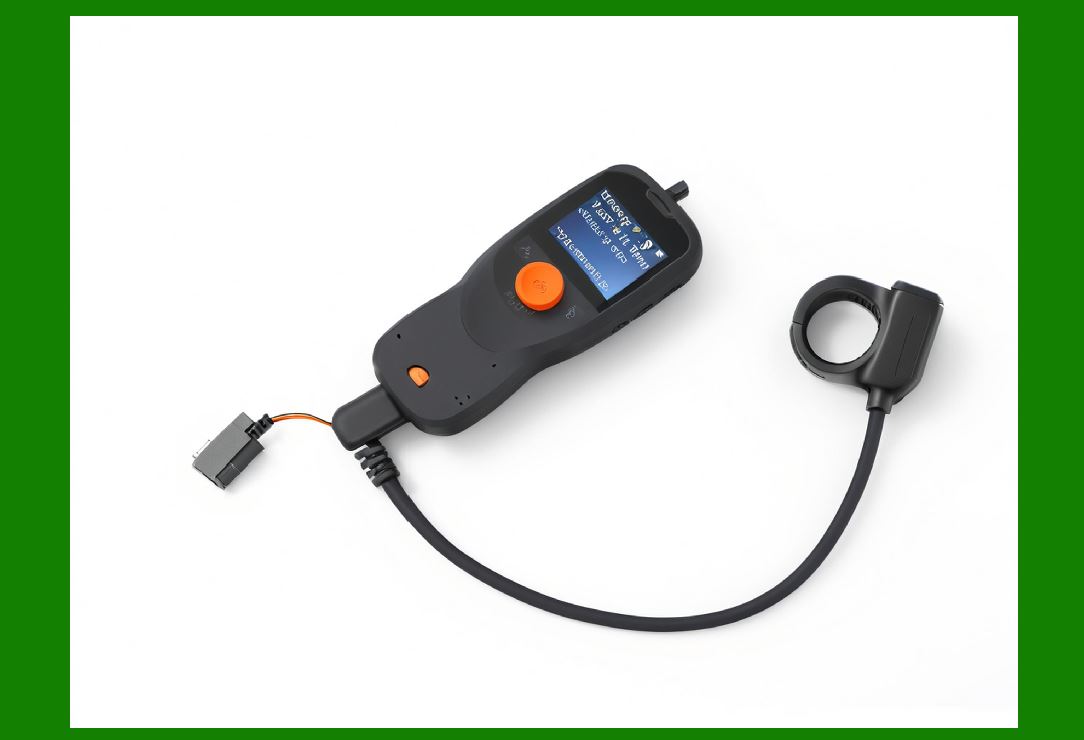
Retail checkout is the most classic application domain of barcode laser scanning and the place where the value of automatic power control is easiest to quantify. A typical omnidirectional multi-line scanner sweeps across product labels at over a thousand times per second at the checkout counter, and the cashier need only pass the item in front of the scan window without precise alignment. This 'scan-and-go' experience rests on one premise: every scan line has sufficient and consistent light intensity to form a decodable return on the label surface. |
Consider the temperature history of a scanner installed at a supermarket checkout counter over the course of a day. When the store opens in the morning, the ambient temperature at the counter may be only eighteen or nineteen degrees; during the midday rush, the register itself, the display, the flow of customers, and overhead lighting together push the local temperature above thirty degrees; if the scanner happens to be directly under an air-conditioning vent or near a hot-air curtain, fluctuations are even more severe. Without automatic power control, morning output power may be twenty to thirty percent higher than at midday. This difference may go unnoticed when reading high-quality new labels, but when a cashier faces a crumpled promotional label with slightly blurred bar-space printing, the return that was decodable in the morning may fall below the decoder's threshold at midday power levels. The result is that the cashier must repeatedly adjust the item angle or manually key in the barcode digits. Each such failure, multiplied during peak hours, becomes visible queue delay. |
The contribution of automatic power control in this scenario is not to raise peak performance but to eliminate 'bad days' of performance. It makes the scanner perform equally well in the first hour and the last hour of the day, and makes window-side and wall-side checkout counters behave consistently. For chain retailers, this means predictability of training costs: cashiers do not need to learn to 'hold items closer at three in the afternoon' because the device itself maintains a constant reading margin. |
Moreover, scanners in retail environments often sit idle for long periods. Many modern models use infrared-sensing wake-up: when no item approaches, the laser enters a low-duty-cycle sleep mode to save energy and reduce thermal load; once the infrared sensor detects motion, the laser immediately returns to full-power scanning. This mode switching places additional demands on automatic power control: during the transient from sleep to wake, the junction temperature may still be changing, and the loop must stabilize power to the operating target within an extremely short time, or the first scan after wake-up may fail. A well-designed control loop can achieve this convergence within milliseconds, whereas a design that omits the closed loop can only rely on the drive value stored before sleep---a value that is likely no longer correct when temperature has already drifted. |
|
5. Warehouse and Logistics: Continuous Crossing from Cold Chain to Ambient |
When handheld scanners move between refrigerated warehouses and loading docks, ambient temperature differences can exceed forty degrees, and the closed loop is the only means by which the same device can work reliably at both ends. |
Warehouse logistics depends on barcode scanning no less than retail, but under far harsher conditions. In a typical distribution center, an operator may have just scanned a pallet of goods in a minus-eighteen-degree freezer, then pushed a cart into a plus-fifteen-degree loading area, and minutes later arrived at a plus-thirty-degree sorting line near rooftop air-conditioning units. The same handheld scanner experiences an ambient temperature span exceeding forty degrees within half an hour, and the threshold current of its internal laser undergoes a corresponding shift of nearly forty percent. |
Without automatic power control, the failure modes in this scenario are clear and predictable. In the freezer, the laser junction temperature is low, threshold current is low, and the same drive current produces higher output power. This sounds like 'better performance,' but it can actually cause receiver saturation during short-range reading. Operators in freezers typically wear gloves and scan at closer distances than at room temperature; strong returns push the receive amplifier into its nonlinear region, bar-space edges become blurred, and decode rates actually decline. When the operator returns to the warm loading area, the laser heats up, threshold current rises, and output power drops; if the labels there happen to be covered with clear tape or have low print contrast, the degradation in signal-to-noise ratio is enough to cause decode failures. |
The role automatic power control plays in such a temperature roller coaster is akin to cruise control in an automobile: it does not change the engine's ultimate capability, but it eliminates the driver's burden of constantly adjusting the throttle as the grade changes. For warehouse managers, this means device performance is no longer a variable that must be 'selected' according to workstation environment---the same scanner model can handle both freezer inventory counts and dock receiving, without the need to specially procure a 'high-power version' for cold zones or use a 'low-power version' in ambient zones. Device versatility directly reduces inventory management complexity and training costs. |
On logistics sorting lines, another source of pressure is variation in the labels themselves. Thermal labels on same-day delivery parcels may have uneven contrast due to printhead aging, or be covered by tape bubbles. Automatic power control ensures the laser always illuminates labels at the design nominal power, maintaining the baseline signal-to-noise ratio of the return signal at a known level. When the decoder reports a read failure, operators and maintenance personnel can more confidently determine whether the problem lies in the label or the scan angle, rather than suspecting that transmit power has quietly declined due to machine heating. |

|
6. Manufacturing Lines: Heat Accumulation and Throughput Under Fixed Installation |
Scanners in industrial environments are often fixed-mounted and run continuously, and the cumulative effect of their own heating causes open-loop drive to deviate from the operating point within hours. |
The key difference between manufacturing workshops and retail or warehousing is duty cycle. A checkout counter scanner may have seconds of gap between scans, and a handheld device may be in standby while the operator walks. But fixed laser scanners installed beside conveyor belts, above assembly stations, or in automated sorting mechanisms often remain active throughout an eight-hour shift or even three-shift continuous production. The laser operates in pulses, but the pulse repetition rate is high, heat inside the package does not have time to fully dissipate into the environment, and junction temperature climbs continuously during the first few tens of minutes after power-on, then stabilizes at a new equilibrium determined by thermal design and ambient temperature. |
This heat accumulation process is fatal to open-loop drive. A drive current calibrated at the factory in a cold state may no longer be sufficient to maintain design power at the junction temperature corresponding to two hours of continuous operation. The output power decline is gradual and therefore does not trigger any hard fault alarm; the line continues running, but the scanner's reading margin slowly contracts. Until one day, when a batch of products with slightly poorer label print quality passes through and the read failure rate suddenly rises, the line supervisor discovers the problem. When tracing the cause, few would suspect that the culprit is a missing feedback loop in the laser drive circuit. |
The value of automatic power control in industrial scenarios is also reflected in suppression of power supply fluctuations. Voltage fluctuations in workshop power environments and transient dips caused by starting and stopping large equipment are all reflected on the supply rail of the laser drive circuit. In open-loop constant-voltage drive, these fluctuations directly modulate output power. Closed-loop control treats supply fluctuations as yet another disturbance to be corrected: the actual light output seen by the monitor diode is the final arbiter, and supply voltage variations are suppressed by loop gain. For automated equipment that relies on the scanner to trigger subsequent actions---for example, sending a signal to a PLC to divert a parcel when the scanner reads a specific barcode---output power stability indirectly ensures consistency of trigger timing. A scan event that decodes a few milliseconds late because of insufficient power may mean, on a high-speed sorting line, that the parcel has already passed the diverting switch. |
|
7. Medical and Laboratory: Hidden Reliability in Quiet Environments |
In hospital pharmacies, clinical laboratories, and blood banks, uninterrupted scanner reliability matters more than speed, and temperature-stable output power is the silent cornerstone of that reliability. |
Barcode scanning in medical scenarios typically does not pursue retail-level scanning speed. When a pharmacist at the pharmacy window scans a prescription barcode and a medication box barcode, movements are relatively unhurried; when a nurse scans a wristband and an infusion bag at the bedside, scanning distance and angle have ample adjustment room. However, these scenarios demand higher 'read it right the first time' performance, because the consequence of a read failure is not merely waiting but possibly an interruption in medication safety workflow. |
A notable feature of hospital environments is non-uniform temperature control. Pharmacies and administrative areas are usually kept at constant temperature, but near certain instruments in clinical laboratories, around low-temperature workstations in blood banks, and in imaging equipment rooms, local temperatures may differ from corridor temperatures by several degrees. A mobile nursing terminal pushed on a cart between different rooms experiences a complex and unpredictable temperature profile for its built-in scanner. The contribution of automatic power control here is to keep the scanner maintaining the same reading behavior across all these microenvironments, so that nurses and pharmacists do not develop avoidance habits because 'this machine seems to work poorly over by the blood bank.' |
A deeper impact lies in data integrity. Every successful medical barcode scan is recorded as a medication administration or sample collection event. If the scanner exhibits intermittent read failures due to temperature drift, operators may turn to manual entry, and the probability of error introduced by manual entry is far higher than by scanning. By eliminating transmit power as a variable, automatic power control makes attribution of scan failures clearer: if the barcode is clear and the scan angle reasonable yet it cannot be read, the problem lies in the label or database matching, not in the optical front end. This attributability has practical value in medical device troubleshooting and quality audits. |

|
8. Outdoor and Field Operations: From Couriers to Field Research |
Outdoor environments push temperature, power supply, and mechanical shock variables to their limits simultaneously, and the robustness of closed-loop control determines whether a device is truly usable within the 'operating temperature range' stated in its datasheet. |
Courier handheld terminals, asset scanners used by power line inspectors, and sample tracking devices in field ecology research share a set of challenges that do not become problems in indoor environments. Device surfaces under direct sunlight on a summer afternoon can easily exceed fifty degrees Celsius, while delivery points on a winter morning may be below minus ten degrees. A device taken from a heated delivery van cab into cold outdoors, or from an air-conditioned truck into a sun-baked loading dock, completes its temperature shock within seconds. Laser junction temperature follows this shock, and threshold current jumps accordingly. |
In these scenarios, the speed and stability of the automatic power control loop face their most direct test. The loop must remain locked during temperature transients and must not lose lock because the monitor diode's dark current varies with temperature or the reference voltage drifts. A poorly designed loop may oscillate during severe temperature changes: output power is over-corrected, swinging above and below the target value, causing some scan pulses to be too high in power and others too low. For the decoder, this pulse-to-pulse power inconsistency is harder to handle than a stable low power, because automatic gain control cannot track such rapid changes within a single scan cycle. |
Another reality of outdoor operations is battery power. The scanner's power budget directly determines operating time per charge. Automatic power control plays a dual role here: it ensures power does not exceed necessary levels, avoiding wasted current producing an excessively strong beam at the low-temperature end when threshold drops; at the same time, it allows the system to moderately boost power when decoding difficulty is detected, to penetrate soiled or low-contrast labels, without maintaining a high-power setting designed for worst-case conditions throughout the entire work cycle. This 'on-demand allocation' capability becomes possible only when the actual light output is monitored in a closed loop. |

|
9. Why Simple Temperature Compensation Is Not Enough |
Schemes that infer threshold shift using thermistors or temperature sensors cannot, in principle, replace a closed loop that directly measures light output. |
A natural question is: since the pattern of threshold current variation with temperature is known to some extent, why not simply measure the laser's temperature and adjust drive current according to a pre-calibrated curveThis approach does exist in engineering practice, but it has a fundamental limitation: it compensates the laser 'on average,' not 'this particular laser.' |
Every laser's threshold-temperature curve has individual variation. Minor manufacturing process fluctuations cause parameters such as active region material composition, quantum well structure, and facet reflectivity to be non-uniform across the wafer. Factory screening can control characteristic differences within a certain range but cannot eliminate them. A temperature compensation curve based on nominal parameters may over-compensate some units and under-compensate others. A closed loop that directly measures light output does not care what threshold the laser 'should' have at a given temperature---it reads the light actually emitted and corrects accordingly. This is a difference in principle, not a subtle difference in accuracy. |
Furthermore, a temperature sensor measures the temperature at the sensor's location, not the junction temperature of the laser's active region. The thermal resistance between them depends on package structure, solder quality, and mounting method, and changes with aging. Under operating conditions where laser self-heating is significant, junction temperature may be more than ten degrees higher than package case temperature. Inferring junction temperature from case temperature, then inferring threshold current, accumulates error at each conversion layer. The monitor photodiode is different: it is integrated in the same package, shares nearly the same thermal environment as the laser, and its output directly reflects the photon flux of the active region. The closed loop bypasses all intermediate inference steps and goes straight to the heart of the problem. |

|
10. The Boundaries of the Closed Loop: What It Cannot Do |
Automatic power control stabilizes average light output, not beam quality, wavelength, or mode characteristics; understanding its limitations is as important as understanding its function. |
For an article aimed at readers of a technical book, clarifying the boundaries of a mechanism is a necessary part of maintaining honesty. The automatic power control loop can maintain the portion of optical power seen by the monitor diode near the target value, but it cannot guarantee the following. |
It cannot guarantee stability of emission wavelength. A semiconductor laser's emission wavelength also drifts with temperature, typically at a rate of a few tenths of a nanometer per degree Celsius. In barcode scanning applications, wavelength drift itself does not directly affect decoding, because the scanner uses the return from the same laser, and wavelength changes do not affect perception of bar-space contrast. However, if the system contains narrowband optical filters or diffractive elements, wavelength drift may change optical path efficiency; in that case, the power loop increases drive current to compensate for optical path loss, but this already goes beyond 'maintaining laser output' into the realm of system-level power budgeting. |
It also cannot guarantee the spatial mode of the beam. Under certain operating conditions, the laser may hop from the fundamental transverse mode to a higher-order transverse mode, changing spot shape and divergence angle. The monitor diode receives a fixed fraction of total power, regardless of how that power is distributed among modes. If the scanner's optical design is sensitive to beam mode---for example, relying on a specific spot ellipticity to form the scan line---then power stability does not equal scan quality stability. In actual products, this risk is managed by restricting the laser's operating current to a range where the mode is stable, and the role of the automatic power loop is to ensure temperature changes do not push the operating point out of that range. |
Finally, the closed loop cannot repair an already degraded laser. With aging, a laser's threshold current may rise irreversibly and slope efficiency decline. The loop will continuously increase drive current to maintain output until the drive circuit reaches its compliance limit or the laser suffers catastrophic failure. In this sense, automatic power control is a mechanism that maintains system consistency from early to mid-life; it delays the time before performance degradation is perceived by users but does not change the physical fact that the device will eventually age. For scanner designers, this means the loop's design goal is not 'maintain forever' but 'keep power deviation within the range allowed by decoding margin throughout the device's design life.' |
|
11. Detailed Summary |
From a single monitor photodiode to an entire industry's trust in scanning reliability, the closed-loop control introduced by Article 47 is the circuit bridge connecting the two. |
Looking back at the thread of this article, Article 47 is placed prominently in the 'Flying Spot and Its Demands' section because it points out an unavoidable physical fact and implies an equally clear circuit response. The physical fact is: a vertical-cavity surface-emitting laser's threshold current moves with temperature at roughly one percent per degree Celsius, and across a handheld device's operating range, this movement accumulates into output power fluctuations of tens of percent. The circuit response is: use a monitor photodiode to continuously read actual light output, and use a feedback loop to correct drive current so that reading stays at the target value. |
The value of this response is concretely demonstrated in application examples across multiple industries. At retail checkout counters, it eliminates the reading margin difference between morning and afternoon, so cashiers need not adjust operating habits as device state changes. In warehouse logistics, it enables the same handheld device to maintain predictable performance between freezers and loading docks, simplifying device management and training. On manufacturing lines, it offsets the gradual power decline caused by junction temperature rise during continuous operation, keeping decode failure rates at a stable level. In medical scenarios, it eliminates transmit power as a suspect in read failures, making fault attribution clearer. In outdoor operations, it maintains continuity of scanning behavior under the dual constraints of severe temperature changes and battery power. |
Closed-loop control is not omnipotent. It stabilizes the portion of optical power perceived by the monitor diode, not wavelength, beam mode, or device lifetime itself. But in the design context of barcode scanners, it is precisely this limited and precise function that allows a semiconductor device inherently sensitive to temperature to be packaged into a world with no respect for temperature, and to complete hundreds of millions of decodes day after day. The conversion from photons to bits finds one of its most pragmatic fulcrums in this small loop described by Article 47. |

|
References |
1. IET Digital Library, 'The temperature dependence of the threshold current Ith in visible vertical-cavity surface emitting lasers,' *IEE Proceedings - Optoelectronics*, 2005. |
2. IET Digital Library, 'Influence of leakage and gain-cavity alignment on the performance of Al(GaInP) visible vertical-cavity surface emitting lasers.' |
3. Google Patents, 'Method and arrangement for controlling and monitoring laser power in barcode readers,' CN102257509B. |
4. Google Patents, 'Method and apparatus for controlling and monitoring laser power in barcode readers,' US20100158055. |
5. Google Patents, 'System for controlling an electrically driven laser,' WO1996007223A1. |
6. Ktindia, 'What scan pattern and power management features distinguish the Honeywell YJ5900 presentation scanner' |
 cs@easiersoft.com