Chapter 33. From Charge Transfer to Local Conversion: CMOS Linear Arrays in Modern Barcode Scanning |
Summary. For nearly three decades, the linear CCD was the quiet workhorse behind the supermarket checkout and the parcel sorting line. Its principle was elegant: photons became charge, and charge was pushed pixel by pixel toward a single output amplifier. But that very elegance carried a hidden tax. Every transfer across the silicon matrix risked losing a few electrons to traps and defects, and the cumulative effect of charge transfer inefficiency (CTI) grew worse as arrays became longer, faster, and more demanding. The CMOS active-pixel sensor changed the bargain. By placing an amplifier inside each pixel, it converted charge to voltage locally, eliminating the long charge-transfer chain altogether. This chapter explains why that architectural shift matters, how it plays out in real scanning hardware, and where CMOS linear arrays have already replaced CCDs across industries ranging from retail to logistics to food sorting and beyond. |

|
1. The Problem with Pushing Charge |
To understand why CMOS linear arrays became attractive for barcode scanning, one must first appreciate what a CCD actually asks of its silicon. In a conventional CCD, the photon-generated charge packet is not measured where it is created. Instead, it is shifted laterally through a sequence of potential wells, gate by gate, until it reaches the edge of the array and the single output amplifier that serves the entire line. For a 2048-pixel linear sensor, that means every charge packet may undergo thousands of individual transfer steps before it becomes a usable voltage. |
Each transfer is imperfect. Defects in the silicon lattice, whether intrinsic to the manufacturing process or introduced over time by radiation, can capture electrons and release them later. The fraction of charge that survives the journey is quantified as charge transfer efficiency. A device that transfers 99.999 percent of its charge per step sounds excellent in isolation, but after two thousand steps the cumulative loss becomes visible. More insidiously, the loss is not uniform. Charge packets that originate farther from the amplifier must survive more transfers, so the image quality degrades across the scan line. In web inspection applications, where small low-contrast defects must be detected against a moving paper or film substrate, this spatial variation in modulation transfer function can reduce the usable field of view or cause real defects to be missed. |
For barcode scanning specifically, the symptom is subtler but no less consequential. A barcode is a spatial pattern of dark and light bars. If the charge representing a narrow bar bleeds into its neighbor, or if a faint element loses proportionally more signal than a strong one, the analog waveform presented to the decoder becomes distorted. At low scan speeds and short arrays, the effect may be negligible. But modern logistics operations demand long arrays, high line rates, and wide fields of view. Under those conditions, CTE becomes a design constraint that cannot be engineered away within the CCD architecture itself. |

|
2. The Active Pixel Insight |
The CMOS active-pixel sensor solves the CTE problem by refusing to play the charge-transfer game at all. In an active pixel, the conversion from charge to voltage happens inside the pixel, immediately after photodetection. A photodiode accumulates charge, and a small transistor amplifier buffered within the pixel converts that charge to a voltage that can be read out over a metallic bus. There is no long journey across the silicon. There is no cumulative transfer loss. The charge packet lives and dies in the same small volume of silicon where the photons landed. |
This architectural difference has consequences that extend well beyond CTE. Because the pixel no longer needs to be a specialized charge-transfer device, it can be fabricated in a standard CMOS process. That means the sensor array can share a die with the timing circuitry, the analog-to-digital converters, the digital signal processing, and even the interface logic. A barcode scanner engine can become a single chip rather than a board full of discrete components. The supply voltages drop from the dozen or more volts often required by CCD clocking to the few volts that standard CMOS logic prefers. Power consumption falls accordingly. A CCD-based camcorder of the 1990s might dissipate ten watts in its sensor and support electronics; a CMOS active-pixel camera-on-chip can operate in the tens of milliwatts range. |
For a barcode scanner, this matters enormously. Handheld scanners are battery-powered. Embedded scanners in self-service kiosks, turnstiles, and locker systems must fit into tight enclosures with minimal thermal headroom. Fixed-mount scanners on production lines need to be compact and reliable, with no high-voltage supplies to fail. The active pixel does not merely fix a physical limitation of CCDs; it enables an entirely different product category. |
|
3. What the Scanner Sees: Active Pixels in Retail Checkout |
The supermarket checkout is the most familiar barcode scanning application, and it is also where the CMOS transition has been most complete. A modern presentation scanner at a cashier lane typically uses a two-dimensional CMOS imager rather than a linear CCD, but the same active-pixel logic applies. The sensor captures a full frame or a rapid sequence of frames, and the decoder locates and interprets the barcode within that image. The ability to read barcodes at arbitrary orientation, without the careful line-by-line sweep required by older laser scanners, comes directly from the parallelism of the image sensor. |
What does the active pixel contribute hereFirst, the integration of analog-to-digital conversion on the same chip as the pixel array allows the scanner to produce digital data almost immediately after exposure. The reference signal and the data signal are sampled at different points during the exposure window, and the difference between them cancels out much of the reset noise that would otherwise contaminate the reading. This is correlated double sampling, and it is the reason a CMOS scanner can deliver clean digital values even under the flickering fluorescent lights of a retail environment. |
Second, the local conversion eliminates the blooming and smearing artifacts that plagued CCD scanners when a highly reflective surface, such as a shrink-wrapped package or a glossy label, passed through the scan line. In a CCD, excess charge from an overexposed pixel can spill into neighboring pixels during transfer, corrupting adjacent bars. In a CMOS active pixel, the charge is converted locally and the readout is essentially non-destructive. The overexposed pixel saturates, but its neighbors remain unaffected. |
The practical result is that a cashier can scan a crumpled, reflective, partially obscured barcode on the first attempt far more often than was possible with earlier linear CCD engines. The scanner does not need to see every bar perfectly in a single sweep. It needs enough clean pixels, in the right places, and the active-pixel architecture delivers that with less fuss. |

|
4. Logistics and Parcel Sorting: Speed, Width, and Reliability |
If retail checkout is the public face of barcode scanning, logistics is its industrial backbone. A modern parcel sorting facility may process tens of thousands of packages per hour, each bearing a label that must be read while the package moves at speed on a conveyor. The scanning geometry is brutal. Labels are tilted, wrapped around corners, smudged, or partially covered by tape. The scanner has milliseconds, not seconds, to capture and decode. |
Linear CMOS arrays have become the sensor of choice for this class of application, particularly in fixed-mount scan tunnels that span the width of a conveyor. A typical high-throughput logistics sensor might use a CMOS linear array with thousands of pixels, running at line rates measured in tens of kilohertz. Teledyne e2v, for example, produces a quad-linear CMOS sensor with 2048 pixels per line and a maximum line rate of 25 kilohertz, intended for sorting, logistics, and pick-and-place applications. The four lines can be configured for color and near-infrared sensitivity, allowing the same sensor to read printed labels and detect features that are invisible to the human eye. |
The CTE advantage is not merely theoretical here. A logistics tunnel may need a sensor array long enough to cover a meter-wide conveyor. In a CCD, that length translates directly into more transfers per charge packet and greater cumulative loss. The active-pixel architecture decouples array length from transfer efficiency entirely. A longer array simply means more pixels, each with its own local amplifier, reading out over a slightly longer bus. The signal from the last pixel is no more degraded than the signal from the first. |
The low supply voltage requirement of CMOS also simplifies the engineering of scan tunnels. These systems are often installed in spaces where running high-voltage lines is inconvenient or regulated, and where maintenance access is limited. A sensor that operates from a single low-voltage supply, with integrated timing and digitization, reduces the number of failure points and the complexity of the wiring harness. |
|
5. Food Sorting and Agricultural Inspection |
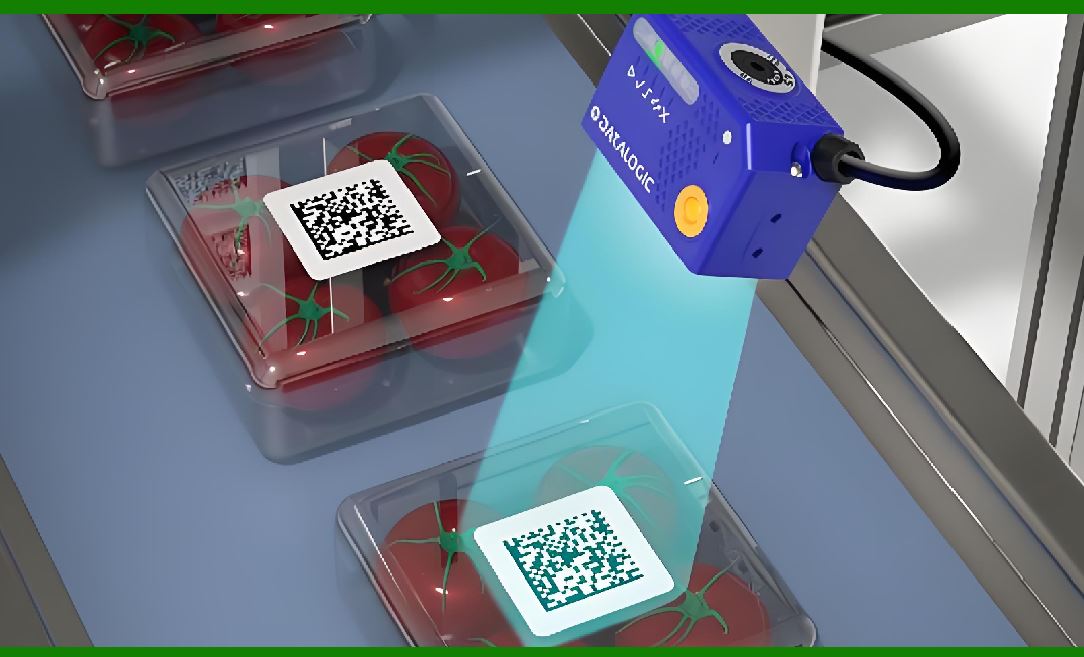
Barcode scanning is not always about labels. In food processing and agricultural sorting, the 'code' being read is the appearance of the product itself: the color of a tomato, the presence of a bruise on an apple, the degree of roast on a coffee bean. The sensor must distinguish subtle spectral and spatial differences at high speed while the product streams past on a conveyor. |
CMOS linear arrays have made significant inroads in this domain precisely because their active-pixel architecture is compatible with the multispectral and color filtering techniques that sorting requires. The Teledyne e2v sensor mentioned earlier includes wafer-level dichroic filters for red, green, blue, and near-infrared channels, each with independent exposure control. A sorting machine can tune the exposure of each channel separately to compensate for varying illumination or to emphasize a particular defect signature. This kind of per-channel flexibility is difficult to achieve in a CCD architecture, where the charge from all pixels must ultimately funnel through a shared output structure. |
Consider the problem of detecting a small dark defect on a light-colored grain. The defect may occupy only a few pixels in the scan direction. If charge from those pixels smears into adjacent pixels during readout, the defect signal weakens and the contrast between defect and background shrinks. The active pixel preserves the spatial integrity of the signal because the charge never leaves the pixel where it was generated. The sorting algorithm receives a sharper, more faithful representation of the product surface, and the ejection system can act on that representation with greater confidence. |
The same logic applies to recycling and mineral sorting, where the 'defect' might be a piece of wrong-colored plastic in a stream of clear PET, or a fragment of unwanted rock in an ore stream. These applications demand high line rates and wide dynamic range, both of which favor the CMOS active-pixel approach. |

|
6. Embedded Scanning: Kiosks, Lockers, and Access Control |
Not every barcode scanner lives in a rugged industrial enclosure or a checkout lane. An increasing number of scanners are embedded in self-service machines: parcel lockers, ticketing kiosks, vending machines, access control readers, and medical devices. These applications impose a different set of constraints. The scanner must be small, inexpensive, power-efficient, and capable of operating reliably with minimal user guidance. |
The integration advantages of CMOS active-pixel sensors are particularly pronounced here. Because the sensor, timing, analog front end, and digitization can all reside on a single chip, the entire scanning engine can be reduced to a module barely larger than a postage stamp. The low supply voltage and low power dissipation mean the module can be powered from the same rail as the host device's logic, with no separate high-voltage supply and no heat sink. The absence of charge transfer means the module can be manufactured in a standard CMOS foundry, with the cost structure of consumer electronics rather than the specialized process requirements of CCD fabrication. |
A parcel locker scanner, for example, must read a barcode printed on a paper label or displayed on a phone screen, often under dim or uneven lighting, through a protective window that may be scratched or smudged. The active-pixel sensor's local conversion and integrated correlated double sampling help maintain signal quality under these imperfect conditions. The scanner does not need to be perfect; it needs to be good enough, cheap enough, and small enough to justify embedding in thousands of lockers that may never see a maintenance technician. |

|
7. The Question of Dynamic Range and Noise |
No sensor technology is without tradeoffs, and the CMOS active pixel is no exception. Early CMOS imagers suffered from higher fixed-pattern noise and lower dynamic range than CCDs, largely because the amplifiers within each pixel were not perfectly matched and because the pixel circuitry occupied area that could otherwise be used for light collection. These limitations have narrowed considerably as fabrication processes have improved, but they have not vanished entirely. |
For barcode scanning, however, the relevant question is not whether a CMOS linear array matches a scientific-grade CCD in every metric. The question is whether it meets the requirements of the application at a lower cost and with greater integration. A barcode scanner does not need to image faint astronomical objects. It needs to distinguish black bars from white spaces under typical lighting, at typical speeds, with high reliability. The active-pixel architecture, combined with correlated double sampling and on-chip digitization, is more than sufficient for that task. |
The dynamic range of a modern CMOS linear sensor can reach 71 decibels or more, with read noise in the single-digit electrons range. That is ample for reading a label under office lighting or a barcode on a parcel under the fluorescent tubes of a sorting facility. The noise sources that remain, such as dark current and reset noise, are well understood and can be managed through circuit design and calibration. The pixel-to-pixel fixed-pattern noise that once plagued CMOS imagers can be corrected with on-chip digital calibration, storing a correction value for each pixel and applying it during readout. |
What the active pixel gives up in absolute uniformity, it gains in architectural simplicity and integration. For a scanner designer, that trade is almost always favorable. |

|
8. Why the Linear Array Persists |
It is worth pausing to ask why linear arrays remain relevant at all in an era of cheap two-dimensional CMOS imagers. A two-dimensional sensor can capture an entire barcode in a single frame, without requiring relative motion between the scanner and the code. Why would anyone still use a line scan sensor that must be swept across the target |
The answer lies in the economics and physics of resolution. A linear array with a given number of pixels can dedicate all of those pixels to a single spatial dimension. A two-dimensional array with the same pixel count must divide them between width and height. For applications that require very high resolution in one direction, such as reading a long barcode on a moving conveyor or inspecting a wide web of material, a linear array provides more useful resolution per unit cost. The line rate can be matched to the conveyor speed, so that each scan line corresponds to a fixed physical distance along the product. This spatial regularity simplifies decoding and defect detection. |
Linear CMOS arrays also avoid the frame-rate limitations of two-dimensional sensors. A two-dimensional imager must read out an entire frame before the next exposure begins, which limits how fast it can capture successive images. A linear array reads out one line at a time, and the line rate can be pushed very high with relatively modest readout bandwidth. For a parcel moving at two meters per second, the sensor must capture a new line every few tens of microseconds to maintain spatial resolution. A linear array is designed for exactly this mode of operation. |
The active-pixel architecture makes the linear array easier to integrate and more robust against the CTE limitations that once constrained CCD line scan designs. It does not replace the linear array; it makes the linear array better suited to the demands of modern scanning. |

|
9. From Photons to Bits, Without the Long Journey |
The title of this book is 'From Photons to Bits,' and the CMOS active pixel is perhaps the purest embodiment of that journey in a barcode scanner. A photon enters the silicon, generates an electron-hole pair, and the resulting charge is converted to a voltage within microns of where it was created. That voltage is amplified, digitized, and delivered to a decoder, all within a chip that may be smaller than a fingernail. The intervening steps that once stretched across a millimeter of silicon and required thousands of careful transfers have been collapsed into a local transaction. |
This collapse is not merely a technical convenience. It changes what a barcode scanner can be. It allows a scanner to run on a coin cell for years. It allows a scan engine to fit inside a phone. It allows a sorting facility to read labels at line rates that would have seemed implausible to the engineers who first adapted CCDs to barcode reading in the 1980s. The CCD made barcode scanning automatic. The CMOS active pixel made it ubiquitous. |

|
Detailed Summary |
The transition from CCD linear arrays to CMOS active-pixel arrays in barcode scanning is driven by a fundamental architectural difference with profound practical consequences. In a CCD, photon-generated charge must be transferred pixel by pixel across the silicon to a single output amplifier. This transfer chain introduces charge transfer inefficiency, a cumulative loss that worsens with array length and manifests as spatial variation in image quality, reduced modulation transfer function, and distorted analog waveforms. For barcode scanning, the result is reduced read reliability under challenging conditions: tilted labels, reflective packaging, and high-speed motion. |
The CMOS active-pixel sensor eliminates the transfer chain by placing an amplifier within each pixel. Charge is converted to voltage locally, and the resulting signal is read out over a metallic bus. This architecture removes CTE as a design constraint, decouples array length from signal degradation, and enables the integration of timing, digitization, and processing circuitry on the same die. The practical benefits include lower supply voltages, dramatically reduced power consumption, smaller form factors, and the ability to fabricate sensors in standard CMOS foundries rather than specialized CCD processes. |
Across industries, the consequences are visible. Retail checkout scanners benefit from correlated double sampling and local conversion, which suppress reset noise and prevent blooming from reflective surfaces. Logistics scan tunnels use long CMOS linear arrays at high line rates to read labels on fast-moving parcels, with array length no longer limited by transfer efficiency. Food sorting machines exploit the per-channel exposure control and multispectral capabilities that CMOS active-pixel arrays enable, detecting subtle defects at production speeds. Embedded scanners in kiosks, lockers, and access control devices rely on the compactness, low power, and low cost of single-chip CMOS engines. In each case, the active pixel does not merely replace the CCD; it enables a level of integration and reliability that the CCD architecture could not achieve. |
The linear array itself persists because it offers resolution efficiency and line-rate advantages that two-dimensional imagers cannot match for certain scanning geometries. The active-pixel architecture makes that linear array easier to design into modern systems, more robust against the noise sources that once limited CMOS imagers, and better suited to the demanding environments where barcode scanning now operates. The journey from photons to bits has been shortened, and in that shortening, the barcode scanner has become something smaller, cheaper, and more capable than its CCD ancestors. |
 cs@easiersoft.com