Summary of This Chapter |
This chapter examines the final analog stage of the barcode scanner signal chain: the comparator. Its task is deceptively simple---to turn the conditioned analog waveform into a clean binary signal of bars and spaces. What makes this stage consequential is the word 'adapt.' A comparator with a fixed threshold works only under laboratory conditions. In the real world of retail checkout counters, hospital wards, warehouse conveyors, and automotive assembly lines, illumination shifts, label contrast varies, and surfaces reflect light unpredictably. The comparator threshold must track these changes, or the scanner fails exactly when it is needed most. The sections that follow explore why fixed thresholds break, how adaptive thresholds work in principle, and---most importantly---how this seemingly narrow circuit detail plays out across a wide range of industries where barcode scanning is not a convenience but a critical operational lifeline. |
|
1. The Problem with a Fixed Line in the Sand |
Imagine drawing a single horizontal line across a piece of paper and declaring that everything above the line is white and everything below is black. Now imagine holding that paper under a desk lamp, then carrying it into a dim corner, then placing it under a harsh overhead fluorescent. The paper has not changed. The ink has not changed. But the line you drew is now in the wrong place. |
A fixed-threshold comparator in a barcode scanner faces precisely this problem. The analog signal arriving from the conditioning stage represents the amount of light reflected from the label. A white space reflects more light; a black bar reflects less. The comparator's job is to decide, moment by moment, whether the current signal level represents a bar or a space. If the threshold sits at a fixed voltage, it implicitly assumes that the difference between white and black is always the same, and that the absolute brightness of the label is always the same. |
Neither assumption survives contact with reality. A label printed on glossy paper under direct sunlight may reflect more light from its black bars than a label printed on matte paper in a dim warehouse reflects from its white spaces. A fixed threshold calibrated for one label will misread the other entirely. The scanner does not see 'black' and 'white.' It sees photons, and the photons obey the laws of optics, not the intentions of the label designer. |

|
2. Why Illumination Changes Everything |
The illumination in a real scanning environment is rarely stable. Consider a retail checkout counter. The scanner sits under a fluorescent tube that may flicker at twice the line frequency. The cashier's hand passes over the label, casting a moving shadow. A customer's phone screen or a nearby display window adds stray light. The label itself may be curved on a cylindrical product, causing the angle of incidence to vary across the symbol. |
In healthcare settings, the problem takes a different form. A nurse scans a patient wristband at the bedside. The wristband may be partly covered by a sleeve or a blanket. The room lighting may be dimmed for a sleeping patient. The wristband material may be soft and slightly wrinkled, scattering light in unpredictable directions. A fixed threshold that worked during a daytime training session may fail entirely during a night shift in a darkened room. |
Warehouse environments introduce yet another set of variables. A conveyor moves packages past a fixed scanner at high speed. The packages arrive in every conceivable orientation, wrapped in clear plastic, matte cardboard, or reflective foil. A label on a glossy box may produce a specular reflection---a bright glare---that momentarily saturates the photodetector, making a black bar appear as bright as a white space. A fixed threshold would interpret this glare as a long space, corrupting the symbol. The scanner must recognize that the signal has been temporarily distorted and adjust its decision boundary accordingly. |
|
3. Contrast: The Vanishing Margin |
Even if illumination were perfectly constant, the contrast between bars and spaces varies enormously across real-world labels. Thermal transfer printers produce sharp, high-contrast symbols. Laser printers on plain paper produce acceptable contrast. But dot-matrix printers on corrugated cardboard produce symbols where the 'black' bars are sparse dots and the 'white' spaces are the cardboard's natural brown. The contrast ratio may be only two to one, or even less. |
In the automotive industry, direct part marking is common. A laser etches a two-dimensional code directly onto a metal engine component. The code is readable not because of ink contrast but because of surface texture---the etched regions scatter light differently than the polished metal. The contrast may be subtle, and it may vary across the surface of a single part due to machining marks or oil residue. A fixed threshold set for a printed paper label would be utterly lost on such a surface. |
The comparator must therefore adapt not only to changes in illumination but also to changes in the label's inherent contrast. It does this by continuously measuring the signal's extremes---the brightest white it has recently seen and the darkest black---and placing its threshold somewhere between them. The threshold becomes a moving target, a decision boundary that repositions itself as the signal's envelope expands or contracts. |

|
4. How Adaptive Thresholds Work in Principle |
The adaptive comparator does not need to be complicated, but it does need to be responsive. In a typical implementation, the circuit tracks the positive and negative peaks of the conditioned signal. The positive peak corresponds to the brightest white encountered; the negative peak corresponds to the darkest black. The threshold is set at a fraction of the peak-to-peak amplitude, often around thirty percent above the negative peak. This fraction represents a trade-off. Set the threshold too high, and the scanner will miss low-contrast transitions---the signal will never reach the threshold. Set it too low, and noise will trigger false transitions. |
The threshold must also update quickly enough to follow changes in illumination but slowly enough to avoid being fooled by the signal itself. If the threshold tracked every instantaneous fluctuation, it would chase the bars and spaces rather than distinguishing between them. The peak detector therefore has a time constant, a kind of memory that smooths the threshold's response over several transitions. This memory is what allows the scanner to survive a brief glare or a momentary shadow without losing the symbol. |
Some designs go further, using two comparators with thresholds offset above and below the center point. The outputs of these comparators are combined to produce a clean binary signal with hysteresis, meaning that once the signal crosses into 'bar' territory, it must cross back past a slightly different level to be considered 'space' again. This hysteresis prevents noise near the threshold from causing multiple spurious transitions. |

|
5. Retail: The Checkout Counter as a Hostile Optical Environment |
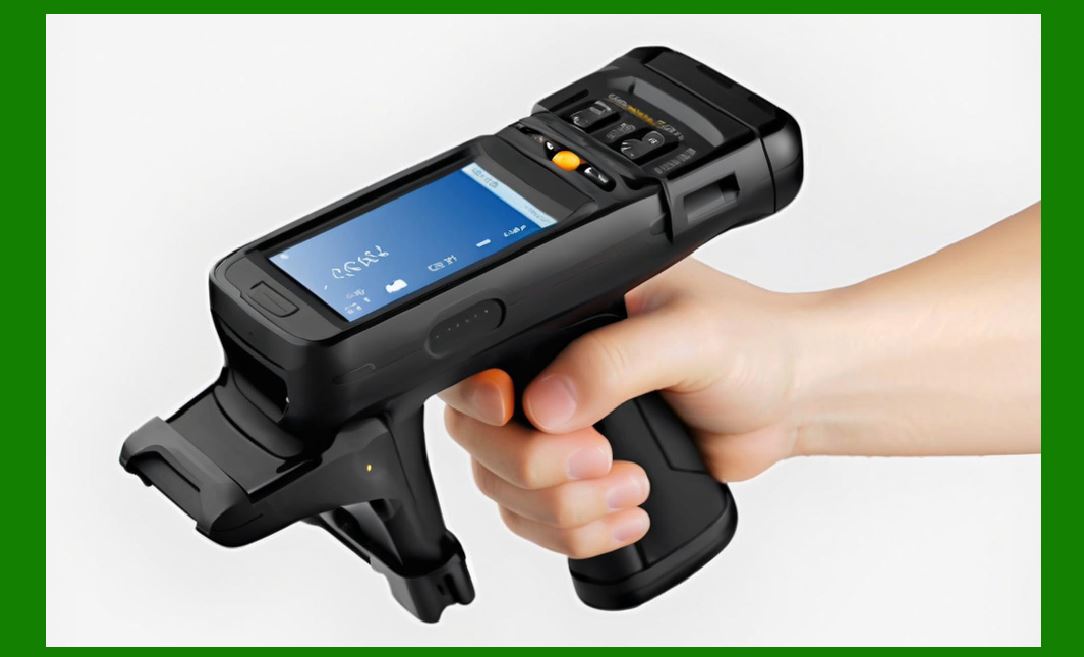
The retail checkout counter is where most people encounter barcode scanners, and it is also where the adaptive threshold faces some of its most demanding tests. A supermarket sells products in packaging that spans the full range of optical properties: shrink-wrapped vegetables with condensation droplets, glossy cereal boxes, matte paper labels on cans, clear plastic bags containing dark objects, and promotional labels printed in colors that happen to have similar luminance to the background. |
Consider a common failure mode: a shrink-wrapped package with a label printed on white paper. The plastic film creates a specular reflection that moves across the label as the cashier swipes the product. For a brief instant, the glare may be brighter than any white space, driving the peak detector to an artificially high level. The adaptive threshold rises to accommodate this false peak, and for the next few milliseconds the threshold is too high for the actual symbol. Transitions that should have been detected are missed. If the scanner's memory is too short, it will lose the symbol entirely. If the memory is well-designed, the threshold recovers within a few transitions, and the redundant scanning of an omnidirectional laser or the multiple frames of an image-based scanner give the system another chance. |
Modern retail scanners often use image sensors rather than laser beams. The adaptive threshold then operates in the digital domain, analyzing each captured frame and computing a local threshold that varies across the image. This approach handles the common situation where one part of the label is brightly lit and another part is in shadow. The threshold is not a single line across the entire image but a surface that bends and flexes to follow the illumination pattern. |
|
6. Healthcare: When a Misread Is a Safety Event |
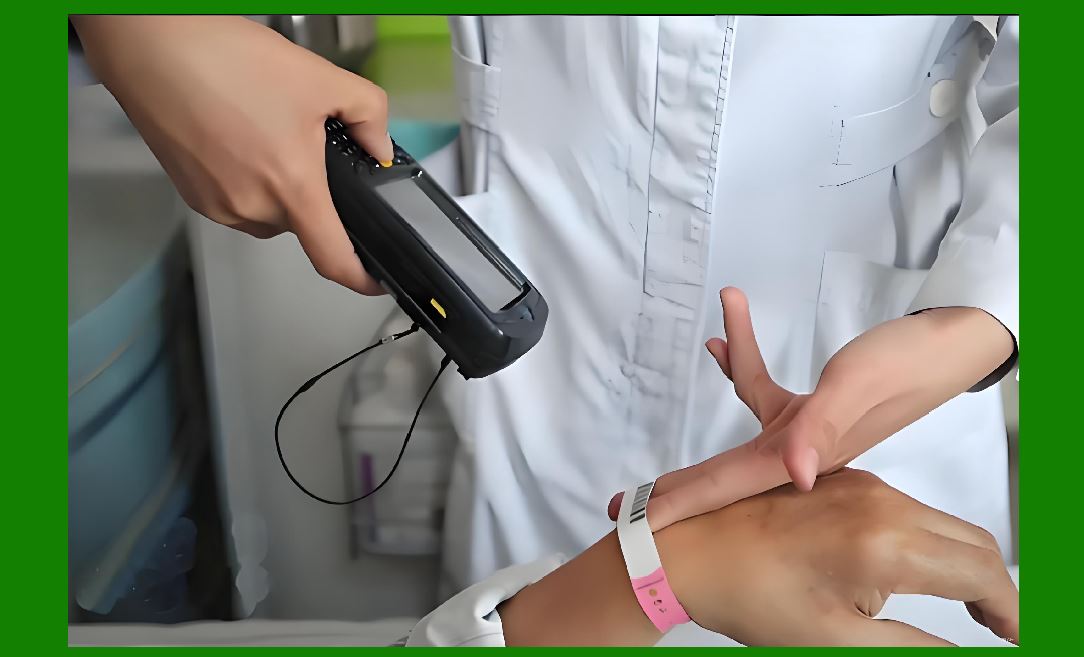
In a hospital, a barcode scan is not a convenience. It is a safety check. The nurse scans the patient's wristband, then scans the medication label. The system compares the two and confirms that the right patient is receiving the right drug at the right dose. If the scan fails, the nurse faces a choice: pause the workflow to troubleshoot, or proceed without the safety check. Neither option is good. |
The adaptive threshold matters here because the scanning conditions in a hospital are nothing like a retail checkout. The wristband may be printed on a soft synthetic material that curves around the patient's arm. The barcode may be partly obscured by a hospital gown or an IV line. The room lighting may be dimmed for a sleeping patient or bright for a procedure. The medication label may be on a small vial with a curved surface and a glossy finish. |
A study of barcode medication administration systems found that 'barcode not readable' was a commonly reported reason for failing to scan medications. While this category can include many causes---damaged labels, poor print quality, incorrect scanning technique---the underlying signal chain's ability to adapt to varied contrast and illumination is a fundamental enabler of readability. A scanner whose threshold is optimized only for ideal conditions will generate more unreadable events, and those events erode nurse confidence in the system and encourage workarounds. |
The stakes are higher than a retail queue. A missed scan in a hospital can mean a medication error reaches a patient. The adaptive comparator, humble as it is, sits at the boundary between a safety system that works and one that gets bypassed. |

|
7. Logistics and Warehousing: Speed and Variety |
A modern fulfillment center sorts tens of thousands of packages per hour. The conveyor moves at a pace that leaves no time for a human to reposition a label. The scanner must read the symbol on the first pass, or the package is diverted to a manual exception lane. Every diversion costs time, labor, and money. |
The packages themselves are a catalog of optical challenges. Poly mailers are shiny and wrinkle-prone. Corrugated boxes have a textured brown surface that provides poor contrast. Labels are sometimes applied at an angle, sometimes partly covered by packing tape, sometimes printed on thermal paper that has been scuffed or smudged. A single conveyor may carry packages from dozens of different shippers, each with its own label stock and printing method. |
The adaptive comparator in a fixed-mount warehouse scanner must handle all of this without human intervention. It must track the signal's peaks from package to package, adjusting its threshold as the contrast and illumination change. When a package with a low-contrast label arrives immediately after one with a high-contrast label, the threshold must settle quickly. When a reflective poly mailer produces a burst of specular noise, the threshold must not be dragged permanently off course by the false peaks. |
In automated sortation systems, the scanner's output feeds directly into the control system that routes the package. There is no human to notice that a symbol was misread due to a threshold error. The package simply goes to the wrong destination, and the error is discovered hours later when a customer complains about a missing delivery. The adaptive threshold is thus a quiet guarantor of the entire logistics network's reliability. |

|
8. Manufacturing and Automotive: Direct Part Marking and the Limits of Contrast |
The automotive industry uses barcodes and two-dimensional codes for traceability at every stage of assembly. A component's code links it to a record of when and where it was made, what materials were used, and what tests it passed. If a defect is discovered in a batch of vehicles, the codes allow the manufacturer to trace the problem back to a specific supplier or production run. |
Many of these codes are not printed on labels. They are etched, laser-marked, or dot-peened directly onto metal, plastic, or glass. The contrast mechanism is not ink on paper but surface texture. A laser-etched code on a machined aluminum surface may be readable only under a specific angle of illumination, and the contrast may vary across the code due to variations in the etching process or the surface finish. |
A fixed threshold is hopeless in this environment. The signal amplitude from a direct-part-marked code may be a small fraction of what a printed label produces. The adaptive comparator must amplify the signal and set its threshold based on the peaks it actually observes, however modest those peaks may be. It must also reject noise from machining marks, oil films, and ambient light in the factory, which may be far stronger than the code signal itself. |
The AIAG standards for automotive labeling specify print quality grades and symbol specifications, but they cannot specify the illumination conditions on every assembly line or the surface finish of every part. The scanner's adaptive threshold is the component that translates those standards into reliable reads under real factory conditions. |
|
9. The Comparator as a Bridge Between Physics and Information |
It is worth stepping back to appreciate what the comparator actually accomplishes. Up to this point in the signal chain, the scanner has been manipulating an analog voltage that represents light intensity over time. The voltage is continuous, noisy, and subject to all the vagaries of optics and electronics. After the comparator, the signal is binary: a sequence of ones and zeros that the decoder can interpret as bars and spaces. |
This transition is not merely a matter of convenience. It is the moment at which the scanner commits to a decision about what it has seen. Every transition in the binary output is a claim: 'at this instant, the signal crossed from bar to space' or 'from space to bar.' If the threshold is wrong, those claims are wrong, and the decoder receives a corrupted message. The decoder may detect the corruption through checksums or symbol structure, but it cannot recover the information that was lost at the comparator. |
The adaptive threshold is therefore an act of interpretation. It says, in effect: 'Given the signal levels I have recently observed, and the rate at which they are changing, I believe that this level represents a transition.' The quality of that belief depends on how well the threshold-tracking circuit has been designed and how well it matches the statistics of the real-world signals it encounters. |

|
10. Lessons Across Industries |
The industries surveyed in this chapter---retail, healthcare, logistics, manufacturing---share a common dependence on the adaptive comparator, but they stress it in different ways. Retail stresses variety and speed. Healthcare stresses reliability under imperfect conditions and the consequences of failure. Logistics stresses throughput and the absence of human oversight. Manufacturing stresses low contrast and surface variability. |
In each case, the design principle is the same: the threshold must be a function of the signal, not a constant. The implementation details differ---analog peak detection versus digital local thresholding, hysteresis versus single-threshold comparison, fast tracking versus slow averaging---but the underlying insight is universal. A barcode scanner that cannot adapt its decision boundary to the light it actually receives is a fair-weather instrument. The adaptive comparator is what makes it a tool for the real world. |

|
Detailed Summary |
This chapter has examined the final analog stage of the barcode scanner signal chain: the adaptive comparator. The key points are as follows. |
First, a fixed threshold fails because illumination and label contrast vary in real scanning environments. The scanner does not see 'black' and 'white' as abstract categories; it sees photon counts that depend on the light source, the angle of incidence, the surface finish of the label, and the optical properties of the packaging. A threshold calibrated for one set of conditions will misread under another. |
Second, adaptive thresholds work by tracking the signal's recent extremes and placing the decision boundary at a fraction of the peak-to-peak amplitude. This allows the comparator to maintain a consistent decision criterion even as the absolute signal levels change. The tracking must be fast enough to follow illumination changes but slow enough to avoid being captured by the signal's own transitions. |
Third, the demands on the adaptive comparator vary across industries. In retail, the challenge is the variety of packaging and the presence of specular reflections from glossy surfaces. In healthcare, the challenge is the safety-critical nature of the scan and the imperfect conditions at the bedside. In logistics, the challenge is high-speed throughput with no human oversight. In manufacturing, the challenge is low-contrast direct part marking on textured surfaces. |
Fourth, the comparator's output is a commitment. Every transition it reports is a claim about what the scanner has seen. Errors at this stage cannot be fully recovered downstream. The decoder can detect some errors, but the information lost to a misplaced threshold is gone. |
Fifth, the adaptive comparator is the component that bridges the analog and digital domains. It transforms a continuous, noisy, light-dependent voltage into a binary sequence that the decoder can interpret. Its quality determines whether the scanner is a fair-weather instrument or a reliable tool for the real world. |
The chapters that follow will build on this foundation, examining how the binary signal is decoded into meaningful data and how the entire signal chain is designed, tested, and refined for the industries it serves. |
 cs@easiersoft.com