Chapter 1. The Universal Signal Chain: One Job, Many Machines |
Summary |
Every barcode scanner, from a forty-dollar supermarket gun to a laser radar in a factory, does exactly one thing: it turns a pattern of light and dark in space into a pattern of voltage in time, and then it decides where the boundaries are. The optics, the light source, the detector, and the decoding software may differ wildly, but the chain of events is the same. This chapter walks through that chain in plain language, shows why it matters, and then visits a dozen industries where the same chain plays out under very different conditions. |
|
1. The One-Sentence Version |
Strip away the plastic, the laser, the camera, the firmware, and the marketing, and every barcode scanner performs a single transformation: it converts spatial reflectance variations into a time-domain electrical signal, and then it decides where the edges are. That is the whole job. Everything else is engineering detail. |
2. Why This Framing Matters |
If you understand the universal signal chain, you can reason about any scanner you will ever meet. You can predict why a scratched label fails in a warehouse but works fine at a pharmacy counter. You can understand why a laser scanner struggles with a phone screen while a camera-based imager reads it instantly. You can debug a system that reads nine out of ten labels and figure out which link in the chain is the weak one. The chain is the mental model that turns a hundred product datasheets into one coherent story. |

|
3. The Chain, Link by Link |
The chain has five links, and every scanner has all five, even if some are hidden inside a single chip. |
3.1 The Light Goes Out. A source illuminates the symbol. It might be a laser spot, a sheet of LED light, or ambient room light. The source determines the color, the coherence, and the intensity of the illumination. |
3.2 The Light Comes Back. Optics collect the reflected light and focus it onto a detector. The collection geometry determines the depth of field, the working range, and the tolerance to tilt. |
3.3 Light Becomes Charge. The detector, whether a photodiode or a CMOS pixel array, converts photons into electrons. This is where the analog world begins to become an electrical one. |
3.4 Charge Becomes Voltage, Voltage Becomes Numbers. An amplifier and an analog-to-digital converter turn the tiny photocurrent into a sampled waveform. In a laser scanner this waveform is continuous and one-dimensional. In an imager it is a two-dimensional grid of samples. |
3.5 Numbers Become Edges. Finally, a processor decides where the transitions are. In a laser scanner this is a comparator and a timer. In an imager it is a scan line extracted from the image and then processed the same way. The output is a list of edge positions, which the decoder turns into characters. |
The key insight is that links three, four, and five are identical in principle for every scanner ever built. The differences live in links one and two, and in how link five is implemented in hardware versus software. |

|
4. The Time-Domain Trick |
Why convert space into time at allBecause electronics is very good at measuring time and very bad at measuring space directly. A photodiode cannot tell you where a photon landed. But if you sweep a spot of light across a symbol, or if you read out a pixel array row by row, the position of a dark bar becomes the moment at which the signal dips. Time is the universal currency, and the edge is the universal event. |
This is why the same decoder logic can serve a laser scanner, a CCD reader, and a modern CMOS imager. Once the signal is a sequence of samples, the rest is arithmetic. |
5. Industry Example: Retail Point of Sale |
At a supermarket checkout, a laser scanner sweeps a spot across the label at hundreds of scans per second. The label is close, clean, and flat. The chain is almost trivially easy: strong return signal, high contrast, predictable speed. The engineering challenge here is not the signal chain but throughput and ergonomics, which is why retail scanners are optimized for speed of presentation rather than depth of field. The same chain that reads a cereal box also reads a loyalty card, because the decoder does not care what the symbol means. |

|
6. Industry Example: Warehouse and Logistics |
In a distribution center, labels are printed on corrugated cardboard, wrapped in shrink film, and read at distances from arm's length to several meters. The return signal is weaker and noisier, the labels are often damaged, and the scanner must tolerate motion. Here the chain's first two links do the heavy lifting: a bright, focused illumination and a collection optic with a large depth of field. The edge-detection link must also be more robust, because a single missed edge means a mis-sort. This is where the difference between a good scanner and a great one becomes visible in uptime statistics. |
7. Industry Example: Manufacturing and Traceability |
On a production line, a scanner may read a direct-part mark etched into metal or molded into plastic. Contrast can be terrible, and the mark may be low-contrast gray on gray. The chain must extract edges from a signal that barely rises above the noise floor. Engineers compensate by choosing illumination angles that create shadow contrast, and by using edge-detection algorithms that are tolerant of gradual transitions. The lesson is that the chain is universal, but the operating point is not. |
|
8. Industry Example: Healthcare and Pharmacy |
In a hospital, a nurse scans a wristband and a medication label before administration. The label may be curved around a small vial, printed on a low-contrast thermal printer, or covered by a clear protective film. The scanner must be gentle, because the light source must not disturb the patient, and it must be reliable, because a misread is a safety event. The chain is the same, but the tolerances are tighter and the consequences of failure are higher. |
9. Industry Example: Transportation and Ticketing |
At a train gate or an airport kiosk, a passenger presents a phone screen or a printed ticket. The screen is a self-luminous display with a glass cover, which reflects ambient light and can confuse a laser scanner. Camera-based imagers handle this better because they can capture the whole symbol at once and apply image processing before edge detection. This is a clear case where a change in link one, the illumination and collection geometry, forces a change in link five, the edge-detection strategy. |

|
10. Industry Example: Agriculture and Food Traceability |
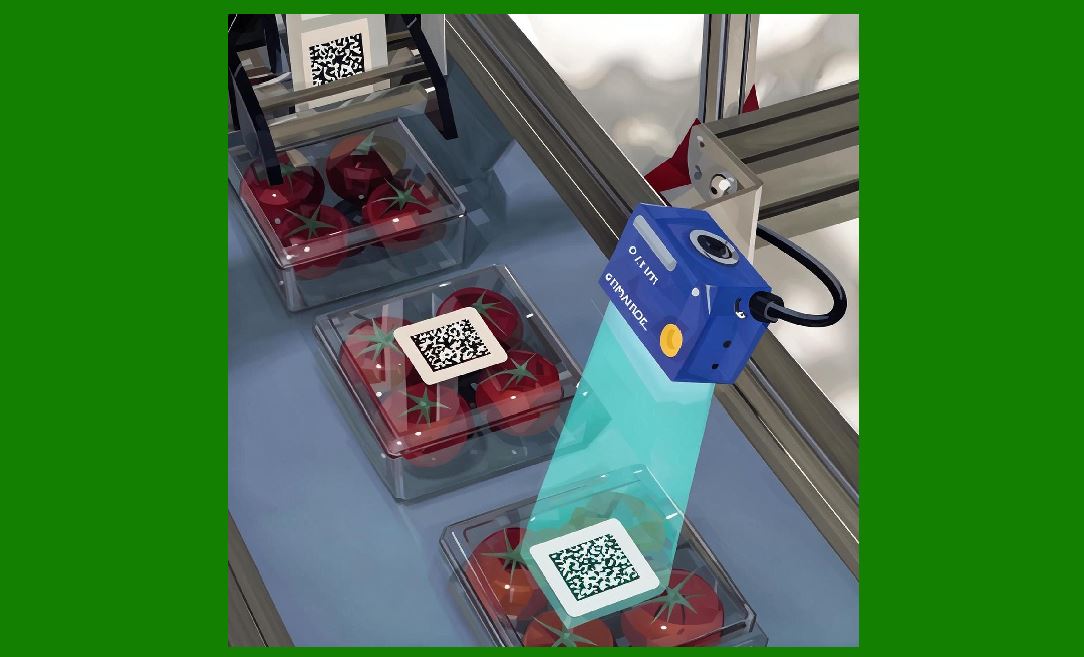
On a farm or in a packing house, labels are exposed to dirt, moisture, and sunlight. A scanner may be mounted on a tractor or a conveyor, reading tags on crates and produce. The signal chain must cope with variable ambient light, which is why many agricultural scanners use modulated illumination and synchronous detection. The principle is unchanged, but the implementation must reject the sun. |
11. Industry Example: Automotive and Heavy Equipment |
In an automotive plant, a scanner may read a vehicle identification number on an engine block or a chassis rail. The surface is curved, oily, and reflective. The chain must handle specular highlights, which appear as bright spots that saturate the detector and erase edges. Engineers solve this with polarized illumination and careful geometry. The edge-detection logic then sees a cleaner signal, and the decoder succeeds. |

|
12. Industry Example: Banking and Document Handling |
In check processing and document scanning, the 'barcode' may be a magnetic ink character or a printed code on a moving sheet. The chain is the same: illuminate, collect, detect, sample, decide. The difference is that the document may be crumpled or skewed, so the edge detection must be tolerant of geometric distortion. This is a good example of how the universal chain extends beyond traditional barcodes to any machine-readable mark. |
13. Industry Example: Access Control and Events |
At a concert venue or a building entrance, a scanner reads a credential at close range, often in low light. The chain is short and the signal is strong, but the scanner must be fast because queues are long. Here the engineering trade-off is between sensitivity and speed, and the chain is tuned for throughput rather than range. |
14. Industry Example: Postal and Parcel Sorting |
In a mail sorting facility, parcels tumble past a scanner at high speed, and labels may be on any face. The chain must capture an image, locate the symbol, and decode it before the parcel moves on. This is where the two-dimensional imager shines, because it can capture the whole scene and let software find the edge. The universal chain is still there, but link five has moved from a comparator to a processor running a search algorithm. |

|
15. Industry Example: Library and Asset Tracking |
In a library, a scanner reads a label on a book spine at a few centimeters. The signal is strong and the label is clean, so the chain is simple. The interesting part is that the same chain serves a handheld scanner, a desktop reader, and a self-checkout kiosk, because the underlying physics does not change with the form factor. |
16. Industry Example: Electronics Assembly |
On a printed circuit board assembly line, a scanner reads a tiny two-dimensional code laser-etched onto a component. The code may be only a few millimeters across, and the contrast may be low. The chain must have high magnification and precise focus, and the edge detection must resolve features at the limit of the optics. This is the chain pushed to its resolution limit. |
17. Industry Example: Cold Chain and Pharmaceuticals |
In a refrigerated warehouse, a scanner must work at low temperatures, where batteries weaken and displays fog. The chain is the same, but the materials and the electronics must be chosen for the environment. This is a reminder that the universal chain is a logical model, not a physical one, and that the physical implementation must survive the real world. |

|
18. Why the Chain Is Universal |
The chain is universal because physics is universal. Photons do not care whether they are reflected from a cereal box or a circuit board. Electrons do not care whether they are generated in a photodiode or a CMOS pixel. The decision logic does not care whether the edge came from a laser sweep or an image row. The universality is not a coincidence; it is a consequence of the fact that all scanners solve the same information problem. |
19. Where the Differences Live |
The differences live in the operating conditions and in the implementation choices. A laser scanner and an imager differ in links one and two, and in how link five is realized. A retail scanner and an industrial scanner differ in the tolerances they must meet, not in the principles they use. Once you see the chain, you can compare any two scanners on a level playing field. |
20. The Edge as the Fundamental Event |
The edge is the fundamental event in every scanner. Everything upstream exists to make the edge detectable, and everything downstream exists to interpret it. If you can find the edge reliably, you can decode the symbol. If you cannot, no amount of software cleverness will save you. This is why the study of scanners is, at its heart, the study of edge detection under adverse conditions. |

|
21. From Edge to Character |
Once the edges are known, the decoder measures the widths between them. A wide bar and a narrow space become numbers, and the numbers become characters according to the symbology rules. The decoder is a translator, and the edge list is the sentence it translates. This is why the same decoder can handle many symbologies: the edge list is a universal intermediate representation. |
22. The Role of Noise |
Noise is the enemy of the edge. It comes from the light source, the detector, the amplifier, and the environment. The chain must be designed so that the signal-to-noise ratio at the edge detector is high enough to make reliable decisions. This is why illumination power, collection efficiency, and amplifier design matter so much: they all serve the edge. |
23. The Role of Motion |
Motion blurs the edge. In a laser scanner, motion across the scan direction is tolerated because the spot is small. In an imager, motion during exposure smears the image, so exposure time must be short. The chain must be designed for the motion profile of the application, which is why a handheld scanner and a fixed-mount scanner have different trade-offs. |

|
24. The Role of Contrast |
Contrast is the height of the edge. A high-contrast label produces a large signal swing, which is easy to detect. A low-contrast label produces a small swing, which requires a quieter chain and a smarter detector. This is why direct-part marking and low-contrast thermal printing are hard problems: they reduce the height of the edge. |
25. The Role of Geometry |
Geometry determines whether the edge is sharp or gradual. A tilted label or a curved surface can spread the transition over many samples, which makes the edge harder to locate. The chain must be designed with the geometry of the application in mind, which is why scanners for curved surfaces use different optics than scanners for flat labels. |
26. A Worked Example in Plain Language |
Imagine a laser scanner reading a label on a moving box. The laser spot sweeps across the label. When the spot is on a white space, the photodiode current is high. When the spot crosses a black bar, the current drops. The amplifier turns the current into a voltage, and the digitizer samples the voltage at regular intervals. The edge detector compares the samples to a threshold and records the times at which the signal crosses the threshold. The decoder measures the intervals between the recorded times and reconstructs the characters. Every step is the same as in every other scanner, only the numbers differ. |

|
27. A Second Worked Example |
Now imagine a camera-based imager reading a phone screen at a train gate. The LED illuminator floods the screen with light. The lens focuses the reflected light onto a CMOS array. Each pixel accumulates charge proportional to the light it receives. The array is read out row by row, and the rows are assembled into an image. The processor finds the symbol in the image, extracts a scan line, and applies the same edge-detection logic as the laser scanner. The intermediate representation is the same, which is why the same decoder library can serve both devices. |
28. Why Engineers Should Care |
Engineers who understand the chain can design better scanners and debug them faster. They can look at a failing application and ask: is the problem in the illumination, the collection, the detection, the sampling, or the decisionThey can choose the right technology for the job instead of guessing. They can explain to a customer why a scanner that works in one environment fails in another. The chain is a diagnostic tool as much as a design tool. |
29. Why Users Should Care |
Users who understand the chain can get more out of their equipment. They can position a scanner correctly, choose the right label material, and recognize when a failure is due to the environment rather than the device. They can ask better questions of their vendors and make better purchasing decisions. The chain is a literacy that pays off in everyday operations. |

|
30. The Chain Beyond Barcodes |
The same chain appears in many other technologies. A magnetic stripe reader converts spatial magnetic variations into a time-domain voltage and decides where the transitions are. A document scanner converts spatial reflectance variations into a time-domain signal and decides where the characters are. A radar converts spatial reflectivity variations into a time-domain signal and decides where the targets are. The barcode scanner is a particularly clear example of a universal pattern, which is why it is worth studying in its own right. |
31. The Chain and the Book |
This book is organized around the chain. Part One establishes the universal signal chain and why it matters. Later parts zoom into each link, then into the design realities of specific scanner types, and finally into the systems-level questions of integration, testing, and reliability. The chain is the spine that holds the book together, and every chapter can be located on it. |
32. A Note on Abstraction |
The chain is an abstraction, and like all abstractions it hides details. A real scanner has power supplies, timing circuits, communication interfaces, and mechanical housings. But the abstraction is useful because it separates the essential from the incidental. When you are debugging, you can descend from the abstraction into the details. When you are designing, you can ascend from the details into the abstraction. The chain is the map that keeps you oriented. |

|
33. The Chain as a Contract |
Each link in the chain makes a contract with the next. The illumination promises to deliver enough photons. The collection promises to deliver them to the detector. The detector promises to convert them faithfully. The amplifier promises to preserve the signal. The digitizer promises to sample fast enough. The edge detector promises to decide accurately. When a scanner fails, one of these contracts has been broken, and the chain tells you where to look. |
34. The Chain as a Language |
The chain is also a language for talking about scanners. Instead of arguing about brands and models, engineers can argue about signal-to-noise ratio at the edge detector, depth of field at the collection optic, and latency in the decision logic. This language is precise, and it is shared across industries. It is the language of this book. |
35. Looking Ahead |
The rest of Part One will examine the chain in more detail, link by link, and show how the same principles apply to laser scanners, CCD readers, and CMOS imagers. Later parts will show how the chain is realized in real products and how it fails in real environments. But the message of this chapter is simple: every scanner does the same job, and once you see the job clearly, the machines become comprehensible. |
|
Detailed Summary |
Every barcode scanner, regardless of its optical engine, performs the same fundamental task: it converts spatial reflectance variations into a time-domain electrical signal and then decides where the edges are. This chapter has presented that task as a five-link chain: illumination, collection, detection, sampling, and edge decision. It has argued that the chain is universal because physics is universal, and that the differences between scanners live in the operating conditions and in the implementation choices, not in the principles. |
The chapter illustrated the chain with examples from retail, warehousing, manufacturing, healthcare, transportation, agriculture, automotive, banking, access control, postal sorting, libraries, electronics assembly, and cold chain logistics. In each case, the same five links appear, but the tolerances, the environment, and the consequences of failure differ. The retail scanner enjoys strong signals and clean labels; the industrial scanner must extract edges from low-contrast marks on curved metal; the healthcare scanner must be gentle and reliable; the transportation scanner must cope with self-luminous screens. |
The chapter explained why the time-domain representation is the universal currency of scanner electronics, why the edge is the fundamental event, and why noise, motion, contrast, and geometry are the four adversaries that the chain must overcome. It gave two worked examples, one for a laser scanner and one for a camera-based imager, to show that the intermediate representation is the same in both cases. |
Finally, the chapter argued that the chain is valuable as a diagnostic tool, a design tool, a shared language, and a map of the book. Engineers who understand the chain can locate failures, choose technologies, and explain behavior. Users who understand the chain can position equipment, choose labels, and ask better questions. The chain is the spine of the book and the foundation for everything that follows. |
 cs@easiersoft.com